Steven M. Muskal, Ph.D.
AI Pioneer | Drug Discovery Expert | Creative Innovator | Serial Inventor
CEO of Eidogen-Sertanty with over 40 years at the intersection of AI, chemistry, biology, and drug discovery. Host of the Renaissance Circle podcast. Builder of Study with Hannah, AI-Steve, Food Health Scan, and AI-Dad.


Projects
Several active projects across drug discovery, AI study tools, personal productivity, health technology, and creative tools. Each one solves a real problem in my own life or work.
Featured
9 projects
cHIA: Human Intestinal Absorption Model
Percent human intestinal absorption, predicted from structure. The deployed model uses 25 consensus descriptors and a random forest fitted on 780 compounds, and it places a compound on the correct side of the 30 percent absorption threshold in 92.60 percent of held-back predictions.
Descriptors are chosen by a genetic algorithm scored on the out-of-bag error of a random forest inside each training group, and every experiment is repeated over 250 stratified extractions and reported as a distribution rather than a single number. The same procedure carries unchanged to cyclic peptides, with a model for permeability across an artificial membrane fitted on 7,298 peptides.
The 1998 method, carried onto nine times the data.
The work is posted as a preprint: Muskal and Wessel, Human Intestinal Absorption Revisited: The 1998 Descriptors Survive, and the Method Extends to Permeability, bioRxiv, 14 October 2026, doi 10.64898/2026.10.03.756481, CC BY 4.0. Every number below comes from it.
In 1998 we published a model that predicted percent human intestinal absorption for 86 compounds from six molecular descriptors and a small neural network (Wessel, Jurs, Tolan and Muskal, J. Chem. Inf. Comput. Sci. 1998). That result rested on one division of the compounds into training, cross-validation and prediction groups. Repeating that division 250 times shows how fortunate a single division can be: 236 of the 250 extractions are worse than the published cross-validation error, 249 are worse than the published external error, and no single extraction matches both. A single split reports one draw from a wide distribution, which is why this work reports distributions instead.
The descriptors themselves held up. Carried unchanged onto 780 absorption measurements, nine times the original set, and given a modern learner, the same six descriptors still reach a correlation of 0.63. The properties they measured, charge, polar surface and hydrogen bond donors, are what a free search over 1,301 descriptors selects today: mean partial charge is chosen in all 250 extractions, hydrogen bond donor count in 72.40 percent, a carboxylic acid fragment in 62.00 percent and topological polar surface area in 35.60 percent.
How a descriptor set is chosen. A genetic algorithm searches descriptor sets whose length is free to vary, drawn from a grid of 5 to 40 descriptors, and each candidate is scored by the out-of-bag error of a random forest fitted inside that extraction's training compounds, so nothing outside the training group is consulted while descriptors are being chosen. That search runs inside each of 250 stratified extractions, each holding back fifteen percent of the compounds. The descriptors that recur across those 250 winners define one frozen set, and because that set is assembled across extractions rather than taken from any one winner, it is scored again over the same 250 extractions with no selection of any kind.
The deployed models, measured on the held-back group. The absorption model gives 20.47 %HIA units rms, 14.79 mean absolute error and a correlation of 0.76 over the 250-extraction re-score, and places a compound on the correct side of the 30 percent absorption threshold in 92.60 percent of held-back predictions. The cyclic peptide model, 25 descriptors fitted on 7,298 peptides, gives 0.82 log10 Papp units rms, 0.49 mean absolute error and a correlation of 0.67. Each model reports the distance from a query to its nearest training compound in that model's scaled descriptor space, against a threshold set at the 95th percentile of the training set's own nearest neighbor distances, and flags a prediction that falls beyond it.

Permeability and absorption are different measurements and are kept apart. An absorption value is the percentage of an oral dose that crosses the human intestinal wall; a permeability value describes transport across a defined barrier in a defined assay, and the endpoint used for a prediction is matched to the experimental question.
ToxPred: what measured compounds resembling yours were found to do
A compound inherits from the compounds it resembles. Draw a molecule, and the measured compounds in a public reference set that are similar enough to it vote on how toxic it is. When nothing is similar enough, the method declines and says so, which is why every accuracy here is quoted with the coverage it was measured on.
It lands within one log unit of the measured rat oral LD50 92.1 percent of the time, on the 1,336 of 1,994 held-out compounds carrying an exact measured value that it answered for, and scores 28 further toxicity endpoints on the same method with nothing retuned.
The 2003 method, rebuilt on the public record.
The work is posted as a preprint: Muskal, Jha, Kishore and Tyagi, Toxicity by Consortium Revisited: Structural Neighbors and Cross-Family Reach, bioRxiv, 14 October 2026, doi 10.64898/2026.10.04.756566, CC BY 4.0. Every number below comes from it.
Twenty-three years ago we published a method that predicts what a compound will do by asking the measured compounds that resemble it: a consortium of structural neighbors votes, and the vote is the answer (Muskal et al., J. Chem. Inf. Comput. Sci. 2003). The data it ran on then was proprietary. That same data is public now and far larger, so the method has been rebuilt on it and revalidated against measurements it never saw. The 2003 work reported 94 percent of answers within one log unit of the measured rat oral LD50; the rebuilt method reaches 92.1 percent on the 1,336 of 1,994 held-out compounds carrying an exact measured value that it answered for, at a required similarity of 0.50. It was then applied unchanged to 28 further endpoints, among them inhibition of the major cytochrome P450 isoforms, cardiotoxicity and clinical toxicity.
A shared pool buys reach. Growing the voting reference set from 127 to 5,953 compounds moves the share of compounds answered for from 3.3 to 46.5 percent, while accuracy rises from 85.4 to 90.9 percent and then holds near 92. A larger consortium makes more calls possible, and groups holding measurements can contribute them to the reference set the vote is taken over.
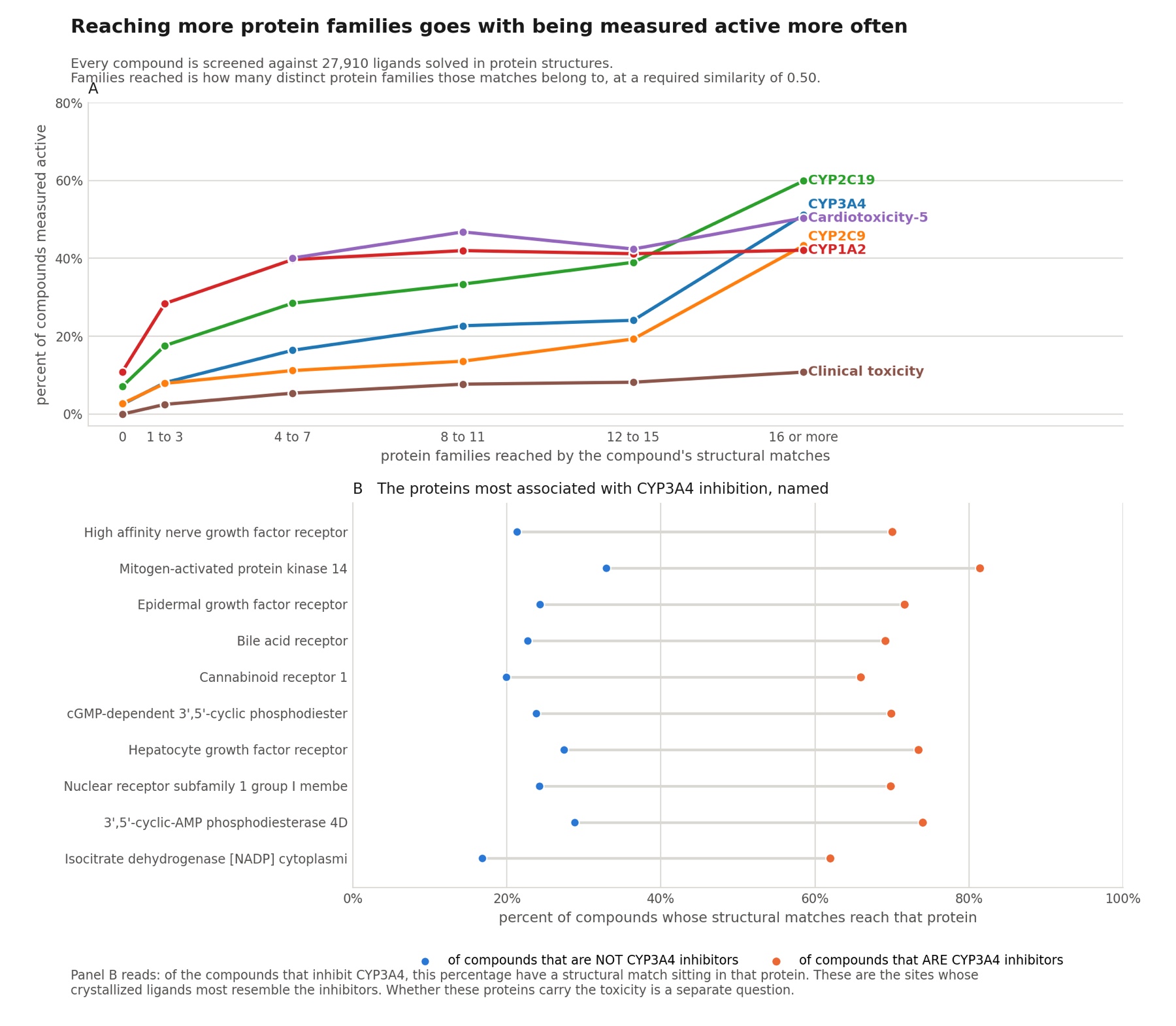
Cross-family reach, the signal 2003 could not compute. Every compound is also screened against the 27,910 ligands solved in protein structures behind Reverse Screen, fingerprinted by PharmCast, and the question is how many distinct protein families those matches belong to, using the family assignments of the Family Foundation Model. A compound whose matches reach no protein family inhibits CYP3A4 2.5 percent of the time; one reaching sixteen families or more inhibits it 51.2 percent of the time. The same shape holds for CYP1A2, CYP2C9, CYP2C19, cardiotoxicity and clinical toxicity. It is computed from ligand similarity alone, from the query's structure.
Reverse Screen returns the proteins a molecule might touch; ToxPred returns what measured compounds resembling it were found to do. Reference measurements are from CATMoS and TOXRIC. For research use: ToxPred reports what resembling compounds were measured to do, and a decision that affects people, products or exposure rests on experimental data.

Foundation Models: which compound, and which target
Comparator models that rank rather than score. Give one a protein sequence and two compounds and it says which the protein prefers. Give the other one compound and two sequences and it says which target the compound prefers. One family spanning model, and two family deep dives.
Family Foundation Model. Which compound a target prefers, and which target a compound prefers, across 34 protein families.
Two separately fitted models over one roster spanning 34 protein families, from kinases and GPCRs to proteases, ion channels and the epigenetic readers, writers and erasers. The compound preference model holds one target fixed and ranks two compounds. The target preference model holds one compound fixed and ranks two targets, from different families or from one family, with each kind measured on its own held-out comparisons. Every answer is an ordering with one number attached, its strength, from 0.5 to 1.0, and the further the strength sits from 0.5 the more often the ordering is right. Trained on ChEMBL 37 alone, so both sets of weights are freely downloadable.
| Compound preference | Target preference | |
|---|---|---|
| Held-out accuracy | 0.71 over 65,725 comparisons | 0.75 over 8,689 between two families 0.78 over 32,738 within one family |
| At strength 0.70 and above | 0.92 | 0.89 between two families 0.91 within one family |
| Targets it can score | 2,079 across 32 families | 2,279 across 34 families |
Either model can be extended with your own measurements. The tools fit trees on your data and merge them into the released forest locally, so your structures and activity values never leave your machine, and a target the model has never seen can be added from its amino acid sequence. The extension guide walks through it.
Deep dives: two families, each with its own potency and selectivity models.
Potency and selectivity rankings across human G protein-coupled receptors.
A deep dive into one family. One model ranks two compounds at a target; the other ranks two targets for one compound. Built on ChEMBL together with Eidogen-curated data. Every target with held-out data carries its own published accuracy.
| Potency | Selectivity | |
|---|---|---|
| Held-out accuracy | 0.77 over 762,493 comparisons, 235 targets | 0.80 over 24,741 comparisons, 211 targets |
| At strength 0.70 and above | 0.94 | 0.93 |
Potency and selectivity rankings across the kinome.
The deepest of the three. Trained on the Kinase Knowledgebase, with ChEMBL used to test rather than to train, so every published figure is measured on comparisons the models never saw. The model weights are for research and evaluation use.
| Potency | Selectivity | |
|---|---|---|
| Held-out accuracy | 0.69 over 1,836,100 comparisons, 477 targets | 0.75 over 3,137,588 comparisons |
| At strength 0.70 and above | 0.88, on 15% of comparisons | 0.92, on 37% of comparisons |
All three share one machinery. A protein sequence is encoded by ESM2 into 480 numbers, a compound becomes a 1,024-bit Morgan count fingerprint plus 14 descriptors, and the whole question sits in one input row, so a random forest returns which side wins, with a prediction strength. Training on the ordered pair means the comparison lives inside the row rather than in a subtraction of two separately predicted potencies, which is what lets the models rank across targets whose assays share no common scale. All three foundation models are also gathered on one page at Eidogen-Sertanty. For the companion demonstration that optimizes pharmacophore similarity instead, see ChIP, and for kinase papers see the related publications.
Drag to rotate
Reverse Screen: given a molecule, the targets it might interact with
Forward screening asks which of many ligands bind one target. Reverse Screen asks the opposite, which is the only question available for a molecule a generative method has just proposed.
Docking one compound into every characterized binding site answers it directly and takes 40.5 hours. Instead every co-crystal ligand in the Protein Data Bank is indexed by the three-dimensional pharmacophore fingerprint it presents, predicted from flat structure by PharmCast, together with the UniProt accessions it was solved against. A query is fingerprinted in 4 milliseconds and compared against all 27,797 indexed ligands, covering 28,579 target sites, in 40 milliseconds. The proteins its nearest neighbors were crystallized against come back as the candidate pool, and AutoDock Vina docks only into those.
Across 3,000 held-out molecules, pooling the five most similar indexed ligands gives 21.1 candidate proteins and contains the molecule's own known target 48.8 percent of the time; pooling twenty-five gives 104.5 proteins and 60.8 percent.
Loading the three dimensional view
acceptor ×2 donor ×3 hydrophobic ×4
Loops that mimic drugs
Nirmatrelvir, the active ingredient in Paxlovid, is a designed peptidomimetic built against the peptide substrate of the SARS-CoV-2 main protease. Search a library of real protein loops by the features they present, and a five residue loop from an unrelated crystal structure comes back presenting the same pharmacophore at 0.913, while sharing only 0.167 of the drug's two dimensional structure.
The drug. Nirmatrelvir, the Paxlovid active ingredient, a designed peptidomimetic covalent inhibitor built against the enzyme's peptide substrate. Ligand ZGW in PDB entry 8GFU.
The loop. Residues 65 to 69 of chain A in PDB entry 2JHX, a RhoGDI mutant crystallized for an entirely different purpose. Sequence AMVPN, relative solvent accessibility 0.679, resolution 1.60 Angstrom. Heavy dark sticks are the drug; light sticks are the loop in the conformation it adopts in 2JHX, not a generated conformer.
What the numbers say. Against a generated low energy conformer of the same sequence the fit is 87.3 with 10 shared features. The real loop gives 79.6 with 9, a change of -7.7, so the conformation nature holds the loop in costs a little of the match rather than making it.
The point of the exercise is direction. A peptidomimetic is normally designed from a peptide toward a drug, and this asks the question backward: given a drug, which real protein loops already present its pharmacophore? Loops come from deposited crystal structures, so each one is a conformation some protein was observed to hold, and the comparison runs on the same PharmPrint three dimensional pharmacophore fingerprints used elsewhere on this site.
That backward question is worth asking because the answer works both ways. Where a peptide reproduces what a drug presents, it is a starting point for rules of peptide mimicry in either direction: what a small molecule has to carry to stand in for a peptide, and equally what a short peptide has to carry to stand in for a small molecule. This case is one result from the wider reverse peptide mimetics study.
Kinase contact maps
What a kinase ligand is actually doing in its pocket, measured from the crystal structure: every hydrogen bond, halogen bond, salt bridge and stacking contact, drawn with its distance and angle, beside the compound's measured potency in the Kinase Knowledgebase. A new structure on every visit.
There are 3,961 figures across 3,893 PDB entries, and the page draws a different one each time it loads. Bound is not necessarily potent, a companion figure, shows one pocket's ligands spanning a millionfold in potency.

Bound is not necessarily potent
Every co-crystal ligand of a protein superposed into one frame, with the measured potency beside each. Within a single pocket the numbers span up to six orders of magnitude, so a solved structure tells you a compound binds and very little about how well.

PharmCast: Rapid Generation of Three-Dimensional Pharmacophore Fingerprints from Two-Dimensional Structure Without Conformer Generation
A three-dimensional pharmacophore fingerprint records the binding features a molecule can present. It is a description of a hand in search of a glove. The descriptor has stayed a niche tool for thirty years because its cost is dominated by conformer generation, so we removed the conformational stage: PharmCast predicts all 10,549 bits of the ensemble fingerprint directly from a SMILES string.
The two routes to a fingerprint, worked through on saquinavir and indinavir, two HIV-1 protease inhibitors of unrelated scaffold. The conventional route generates a conformer ensemble and runs the reference calculation over it; PharmCast predicts the same ensemble record from the two-dimensional structure and skips the ensemble entirely. The reference calculation puts the pair at a pharmacophore Tanimoto of 0.841, against a two-dimensional Morgan Tanimoto of 0.303. The predicted value is shown in panel E.
The descriptor is the one described in the PharmPrint work: each of 10,549 bits is one three-point pharmacophore, three typed features and the three binned distances between them, and a molecule sets a bit when any accessible conformation presents that triangle. Because the bit records that a molecule can present that triangle in some accessible conformation, without asserting that it presents it in any particular pose, it is closer to a property of molecular constitution than of any single geometry, and constitution is what a two-dimensional structure encodes. It is a weaker claim than predicting a conformer, which is why it is tractable where conformer prediction remains hard. The network is deliberately simple: a 2,048 bit Morgan fingerprint of radius 2 alongside 11 whole molecule descriptors, 2,059 inputs in all, through two hidden layers of 1,024 and 512 units to all 10,549 bits, for 8,045,877 parameters trained by minimizing binary cross entropy.
Timed on catalog compounds, the conventional route requires 2.86 s per molecule, of which 2.82 s is conformer generation and 0.039 s is the fingerprint calculation itself. Since the bit calculation is only 1.7% of the total, accelerating it changes nothing; anything that materially moves the economics has to remove the conformational stage. One PharmCast fingerprint costs 0.288 ms in a library-scale batch, and starting from two SMILES strings we obtain a similarity in 0.584 ms against 5.71 s. Screening the complete 4.65 million compound Enamine collection against a reference takes 29.3 minutes, measured end to end at 2,644 compounds per second on six worker processes, against an extrapolated 3,697 core hours by the conventional route.
All timings were measured on one machine, an Apple M3 Ultra with 28 CPU cores, a 60 core GPU and 256 GB of unified memory, running macOS 26.5.1 with PyTorch 2.9.1 on CPU. The GPU was not used, and both routes were timed on the same hardware.
Version 10 was trained on 5,887,229 molecules drawn from a screening collection, activity-backed ChEMBL compounds from 142 to 1000 Da, and peptide loops excised from crystal structures, with a molecular-weight-stratified one percent held back for early stopping. It is evaluated on three chemically distinct populations, all unseen during training: 155,648 real, purchasable Enamine screening collection compounds that the training-set ingest filter excluded, checked by canonical SMILES against all 4,617,292 screening collection structures; 139,700 activity-backed ChEMBL molecules not present in the training set; and 13,500 peptide loops reserved for testing, 9.9% of the full peptide set. Median fingerprint error, Pearson r and pairwise ranking accuracy are 0.008, 0.980 and 0.936 for screening collection chemistry; 0.016, 0.984 and 0.952 for loop peptides; and 0.027, 0.936 and 0.889 for activity-backed ChEMBL compounds. The reference calculation reproduces itself at an error of 0.006 and r of 0.995. Taken one molecule at a time, the median Matthews correlation coefficient is 0.881 on the screening collection, 0.914 on loop peptides and 0.860 on ChEMBL.
Where it is weakest. ChEMBL is the weakest population, with a median error of 0.027 and roughly one pair in four falling outside 0.05, and agreement declines at the upper end of the mass range where the source sets are thinnest. The model predicts the ORed ensemble fingerprint, so where an application requires the matching geometry of a particular conformer, that must come from the reference calculation. Predicted similarity inflates under optimization pressure, since a search that maximizes it selects the molecules the model overestimates; we therefore recommend the surrogate for ranking, the reference calculation for final decisions, and a broad survivor set for rescoring.
PharmCast is joint work with Malcolm J. McGregor, co-author of the original pharmacophore fingerprinting papers the descriptor comes from, and is described in a paper posted to bioRxiv on 7 September 2026, doi 10.64898/2026.09.02.748999. The code, model utilities, documentation and trained weights are public at github.com/smuskal/pharmcast under Apache-2.0; the full method, benchmarks and applicability domain are on pharmcast.ai, and the weights and their SHA-256 digests on pharmcast.ai/models.
ChIP: Pharmacophore-Driven De Novo Design
Take a marketed drug. Design a molecule that presents the same three-dimensional arrangement of binding features on a scaffold that looks nothing like it, reachable in a few steps from catalog building blocks. The campaign below delivers two of them.
See the CampaignChIP searches reaction routes rather than molecules. A gene is a synthesis route: it names the transforms and the catalog blocks fed into them, is enumerated into the products it would make, and those products are built in 3D and fingerprinted against the reference with PharmPrint-style 3D pharmacophore fingerprints. Because every candidate is by construction the product of real reactions on orderable material, the output is synthesizable by design. The two easy alternatives both fail here: screening a catalog by 2D similarity returns analogs, which is the thing being avoided, and generative models return molecules that may not be makeable.
A campaign runs in three phases. Phase 1 searches reaction sequences, asking which sequence of transforms can reach the reference pharmacophore at all, and stops when the population collapses onto one. Phase 2 freezes that sequence and searches the catalog blocks that fill its slots, so a gene becomes one purchasable block per slot and enumerates to exactly one molecule; this is the phase that delivers the purchasable design. Phase 3 keeps route and slots fixed and edits the parts of each block the reaction does not touch, asking how much better the design would be if the catalog were slightly richer. Phase 3 products are virtual satellites of the Phase 2 design rather than orderable compounds.
The reference is Orforglipron, Lilly's oral GLP-1 receptor agonist approved in April 2026. Fitness was pharmacophore similarity and nothing else; 2D Morgan similarity was recorded for every product but never entered selection. Two campaigns were run against it and each converged on a different reaction sequence, so the report delivers two independent designs. Design 1 was scored by the reference conformer calculation. Design 2 came from a separate campaign scored by PharmCast, the surrogate that predicts the same fingerprint from 2D structure, which is what made a second search of that size affordable.
The two designs, side by side
| Design 1 | Design 2 | |
|---|---|---|
| Pharmacophore similarity to Orforglipron | 0.838 | 0.810 |
| 2D Morgan similarity | 0.138 | 0.145 |
| Shape Tanimoto in the overlay | 0.438 | 0.495 |
| Best single conformer pair | 0.659 | 0.633 |
| Formula and weight | C35H32N2O9, 624.6 | C39H35BrF2N6O4, 769.6 |
| Route | 2 steps, 3 blocks | 3 steps, 4 blocks |
| Scored during the search by | reference calculation | the PharmCast surrogate |
Both designs do the thing the search was after: pharmacophore similarity high, 2D similarity at the floor, and that 2D value stayed low on its own without ever being penalized. Across design 1's 115 retained designs, pharmacophore similarity ranges from 0.824 to 0.838 while Morgan similarity stays between 0.081 and 0.174. These are not Orforglipron analogs; they are structurally distinct scaffolds presenting a similar arrangement of features in space.


Limitations. This is a computational simulation. No potency model and no target structure were used anywhere in either search, and nothing here predicts activity at the GLP-1 receptor or any other target. No molecule described has been synthesized and no assay has been run. A high pharmacophore Tanimoto means the candidate can present a similar arrangement of features across its accessible conformers; it does not mean the candidate adopts that conformation when bound, or that it binds at all. The routes were enumerated by reaction transforms and have not been reviewed by a synthetic chemist: no protecting group strategy or order of addition was considered, regiochemistry and stereochemistry were not checked, and no route has been run. Design 1 leaves two stereocenters undefined, so material made to that specification would be a mixture. Conformer ensembles inside the search loop are kept to 100 per molecule for cost, so ranking near the top of the list is not sharp and survivors should be rescored at full ensemble settings. Building block availability came from catalog identifiers and was not confirmed against live supplier stock, pricing or purity. Read the whole thing as a search result, not a biological claim. It is a different demonstration from the Kinase Foundation Model, where the objective was predicted potency.
AI & Personal Productivity
5 projects
Study with Hannah: Medical School Study Cards
Searchable medical school study cards with USMLE prep notes, medical images, and an AI study tutor.
Request AccessTens of thousands of medical-school flashcards and lecture notes across anatomy, physiology, pathology, pharmacology, and immunology, with keyword plus semantic image search. Hannah keeps the archive current throughout her studies; the public landing page introduces the system, while the study content is access-controlled.
Counts update from the Study with Hannah public archive feed.
AI-Steve: Personal Research & Coaching Assistant
My daily companion for research recall, journaling, and family knowledge capture. AI-Steve pulls in emails and attachments, calendar events, to-do items, iMessages, Mac Photos plus curated imports, chat sessions, Q&A, and Socratic pairs extracted from mail, embedding them into PostgreSQL so Claude can respond with grounded context. Search Content, sentiment, and health intelligence fuel daily reflections (including 1, 3, 5, 7, and 10-year lookbacks) plus end-of-week recaps that project the week ahead. Built entirely through natural-language coding (speaking into Wispr Flow driving agentic CLIs like Droid, Claude Code, Codex, Gemini CLI) and able to handle small coding or automation projects on demand, similar to how I built Toast apps and AI-Dad.
Features at a glance
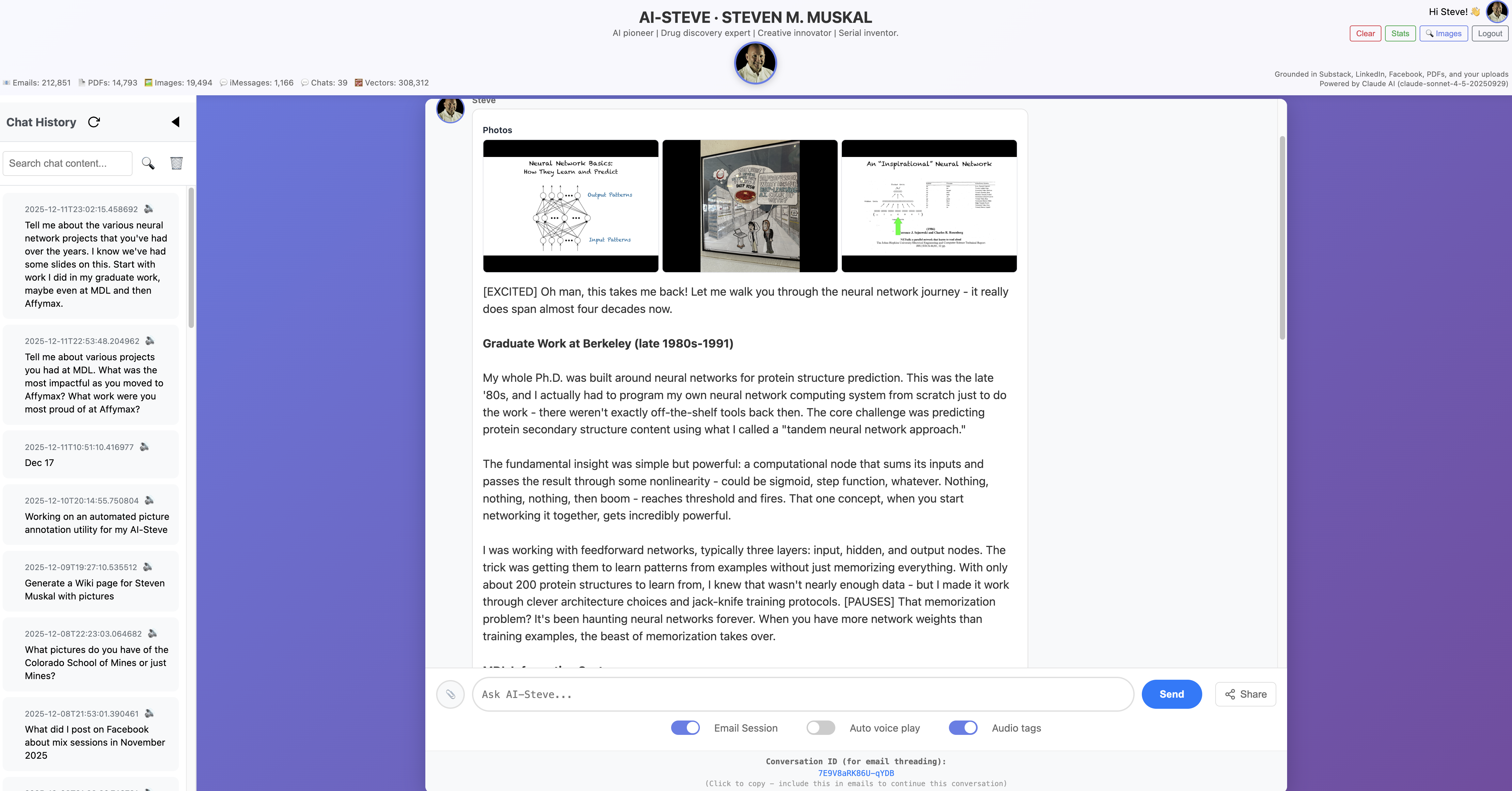
Chat UI grounded in embeddings and transcripts with instant access to images and stats.
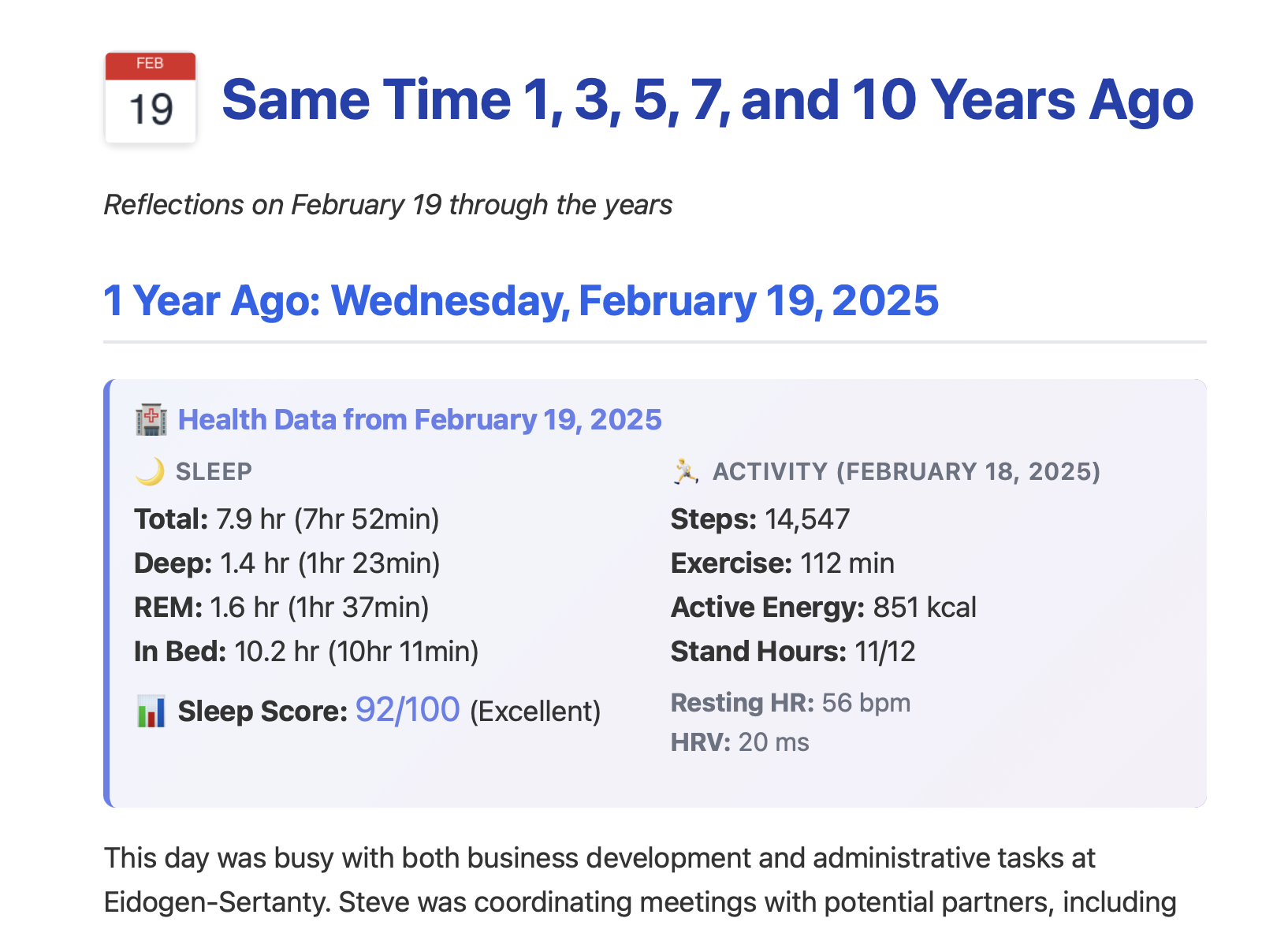
Multi-year reflections surfaced daily (1, 3, 5, 7, 10 years ago).
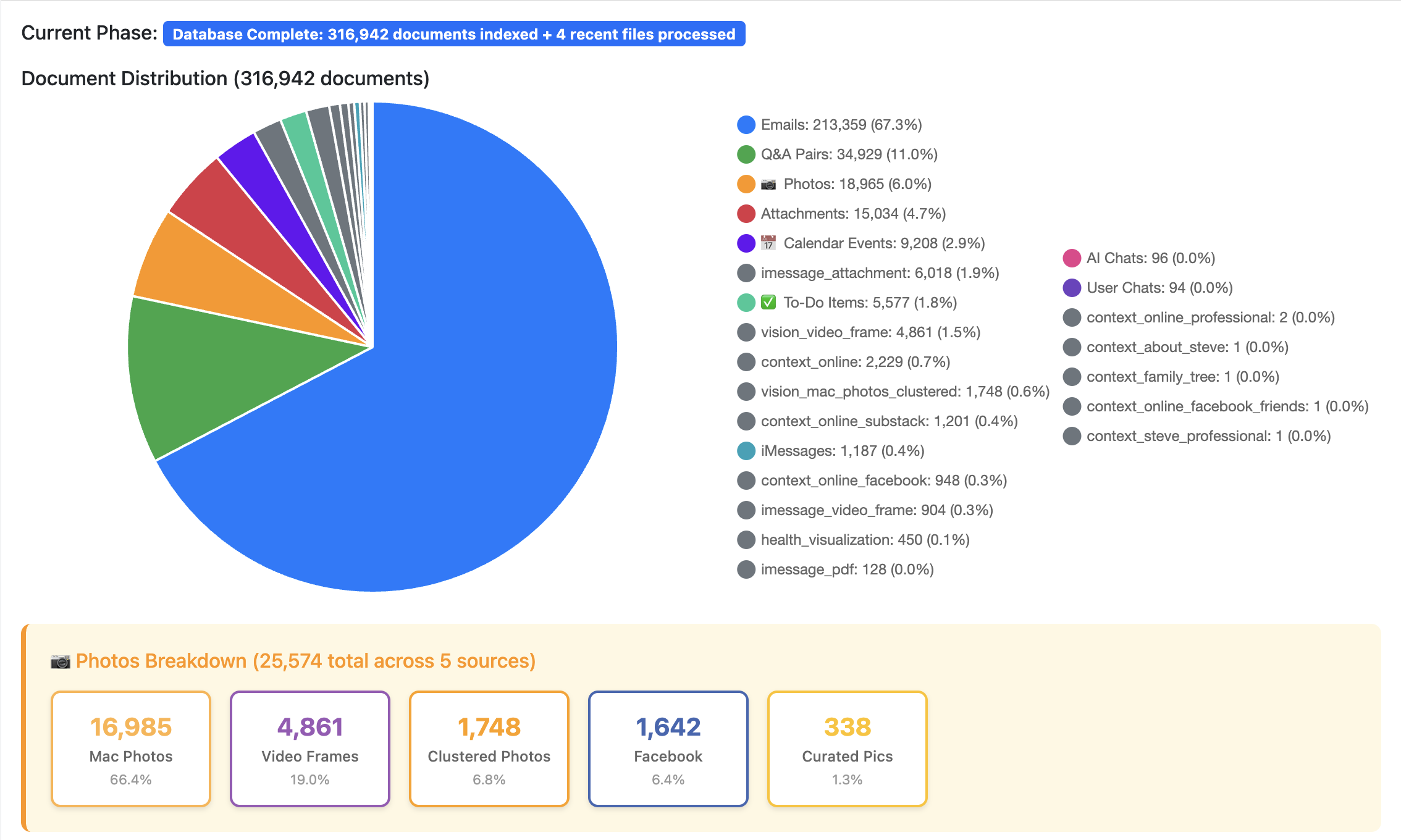
Live mix of emails, Q&A, photos, attachments, calendar, to-dos, iMessages, and curated imports.
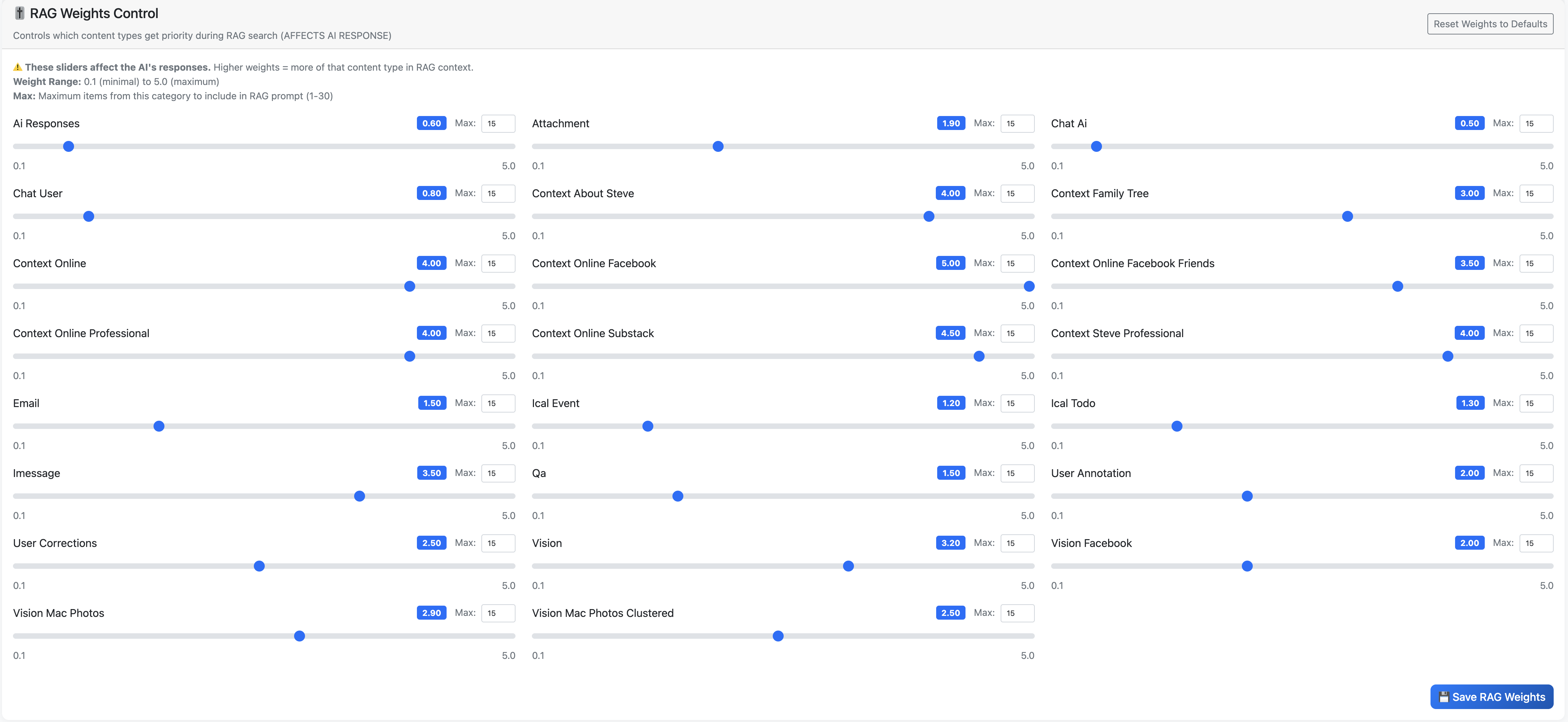
User-modifiable RAG weight control.
AI-Dad: Preserving Legacy Through Conversational AI
An innovative application of RAG (Retrieval-Augmented Generation) technology to create an interactive AI assistant embodying 60+ years of intellectual property legal expertise and family wisdom. Built using natural language programming and Claude Code, this deeply personal project preserves my father's extensive knowledge in IP law alongside decades of family history and personal interactions, making his guidance on both legal and life matters accessible for future generations.
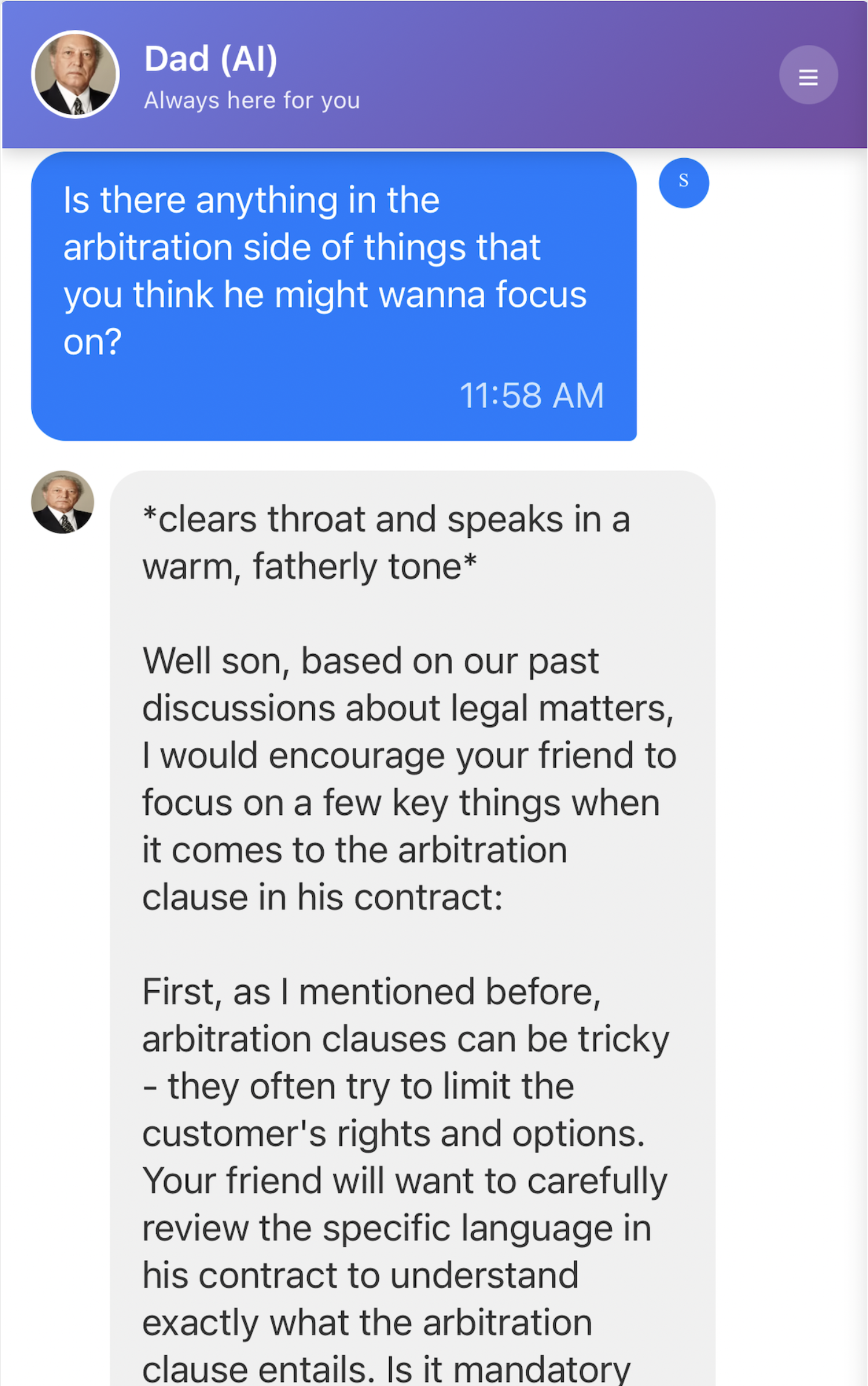
Legal Expertise
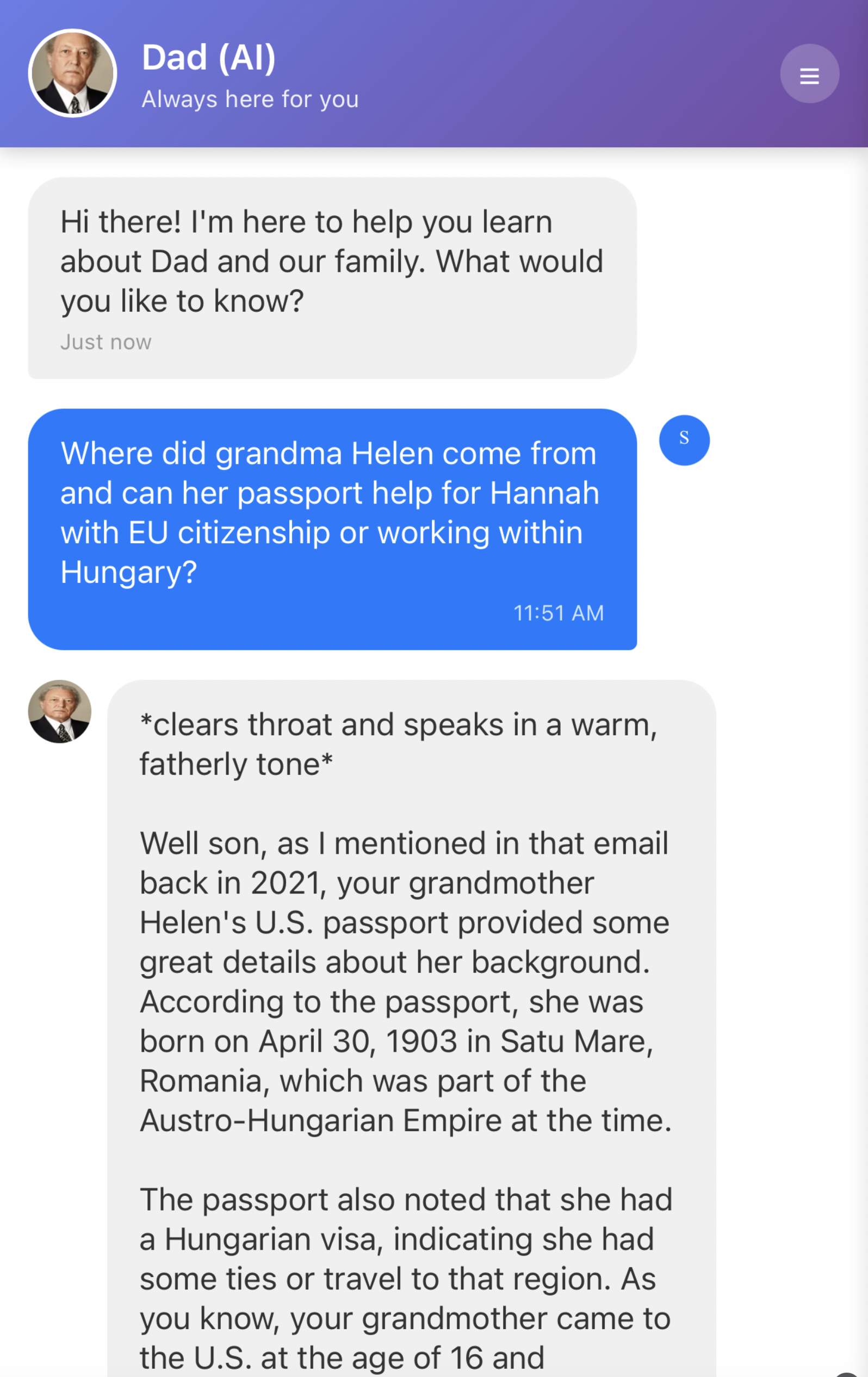
Family Wisdom
AI-Dad: Always here for you - Combining decades of legal expertise with heartfelt family wisdom
Image Explorer: Visual Memory Engine
A CLIP (Contrastive Language-Image Pre-training) + pgvector-powered explorer for my photo archives. Nightly clustering keeps similar sets together so I can browse clusters, select many images at once, and annotate entire groups without touching each file. I can also annotate straight from similarity search, including sub-images and video frames, accelerating how visuals become structured context for AI-Steve’s RAG. Built by speaking English into Wispr Flow to orchestrate Droid, Claude Code, Codex, Gemini CLI, similar to Toast apps, AI-Dad, and AI-Steve.
What it does
- 🔍 Similarity search with thresholds
- 🗂️ Nightly clustering; annotate whole sets
- 📝 Inline annotations saved to DB + JSON
- 🖼️ Finder deep links for fast triage
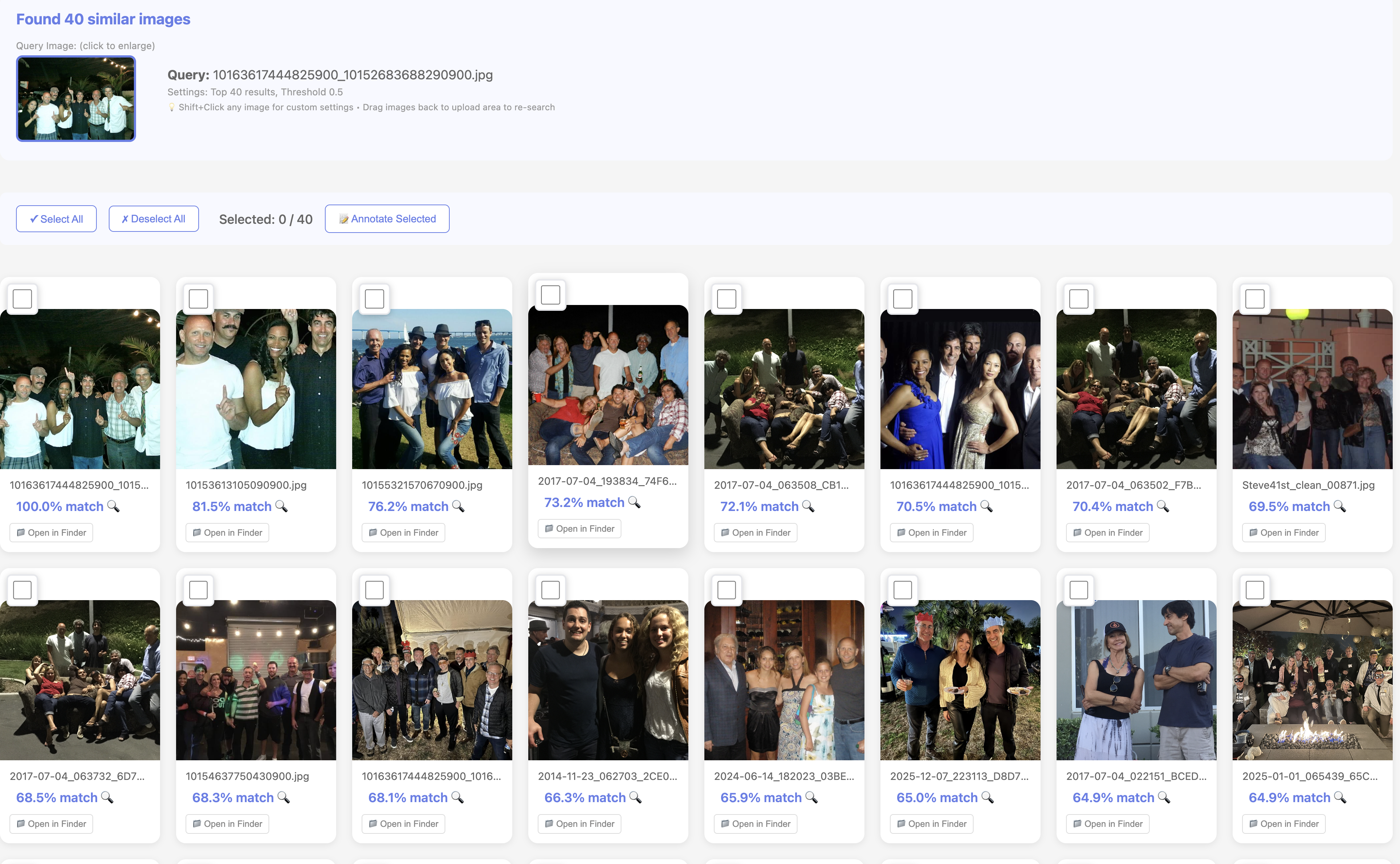
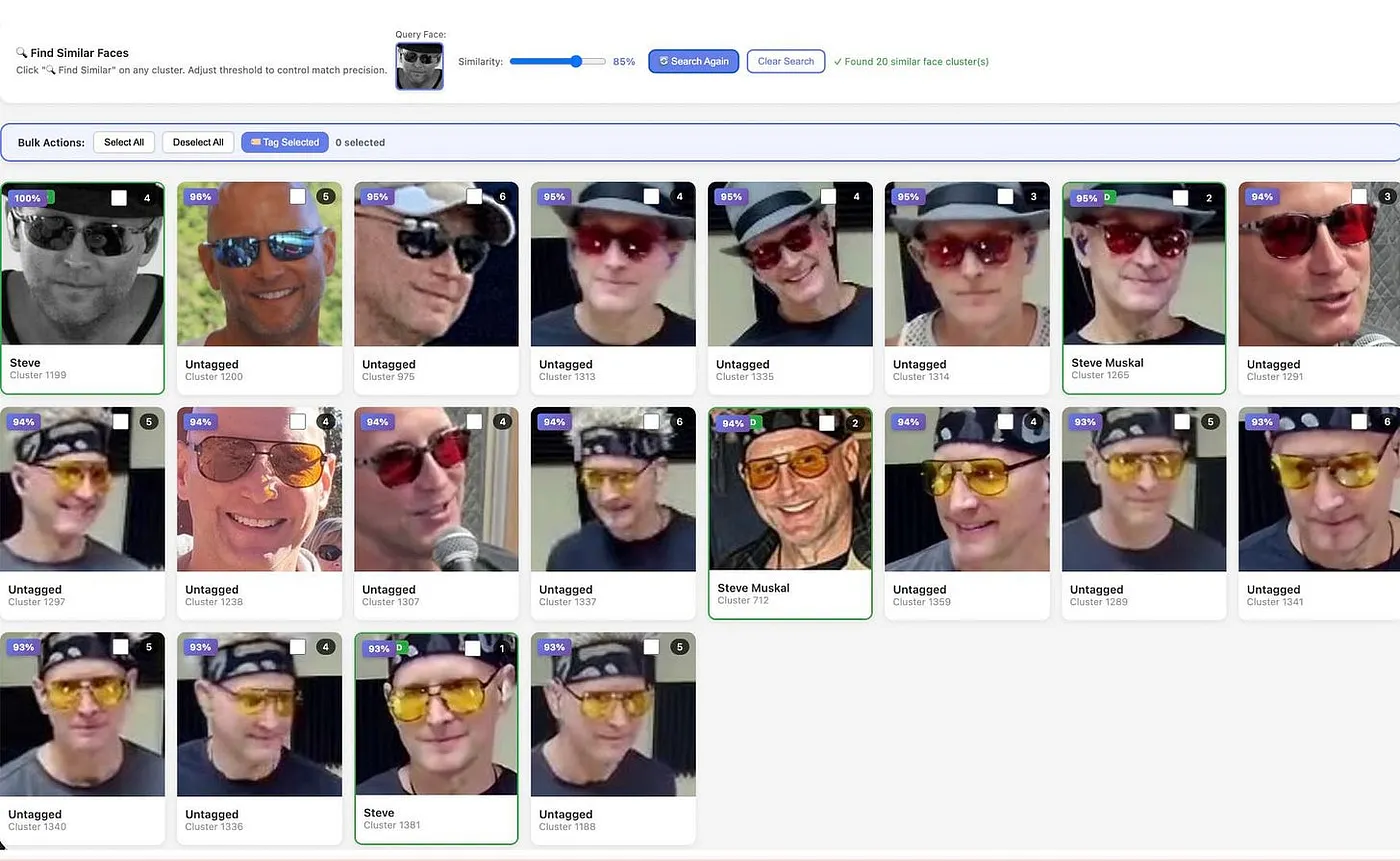
Bulk similarity hits with instant “Annotate Selected” to speed group labeling.
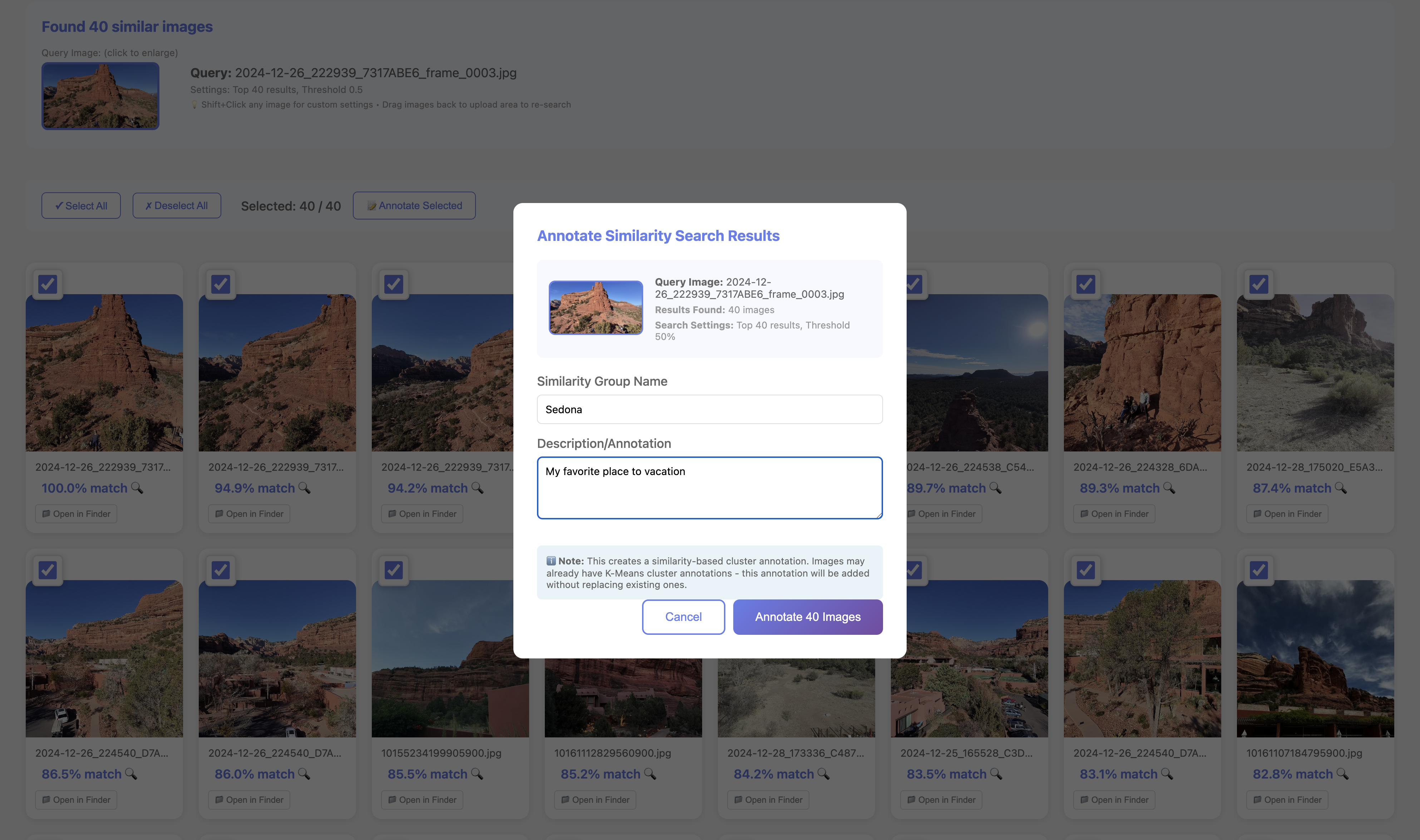
Annotation modal on similarity results to label entire groups in one pass.
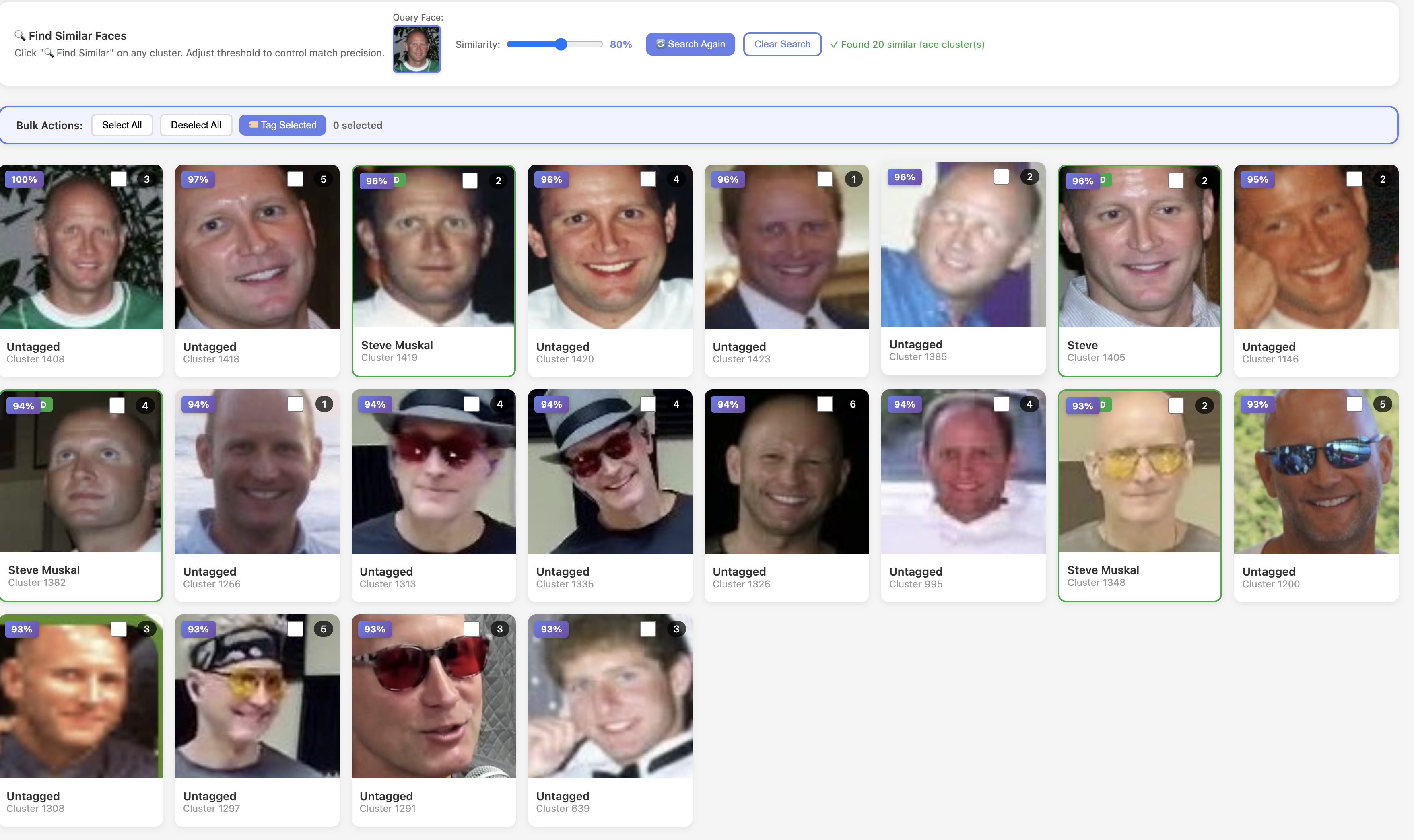
Face extraction and clustering from Mac Photos and video frames, enabling rapid tagging and propagation.
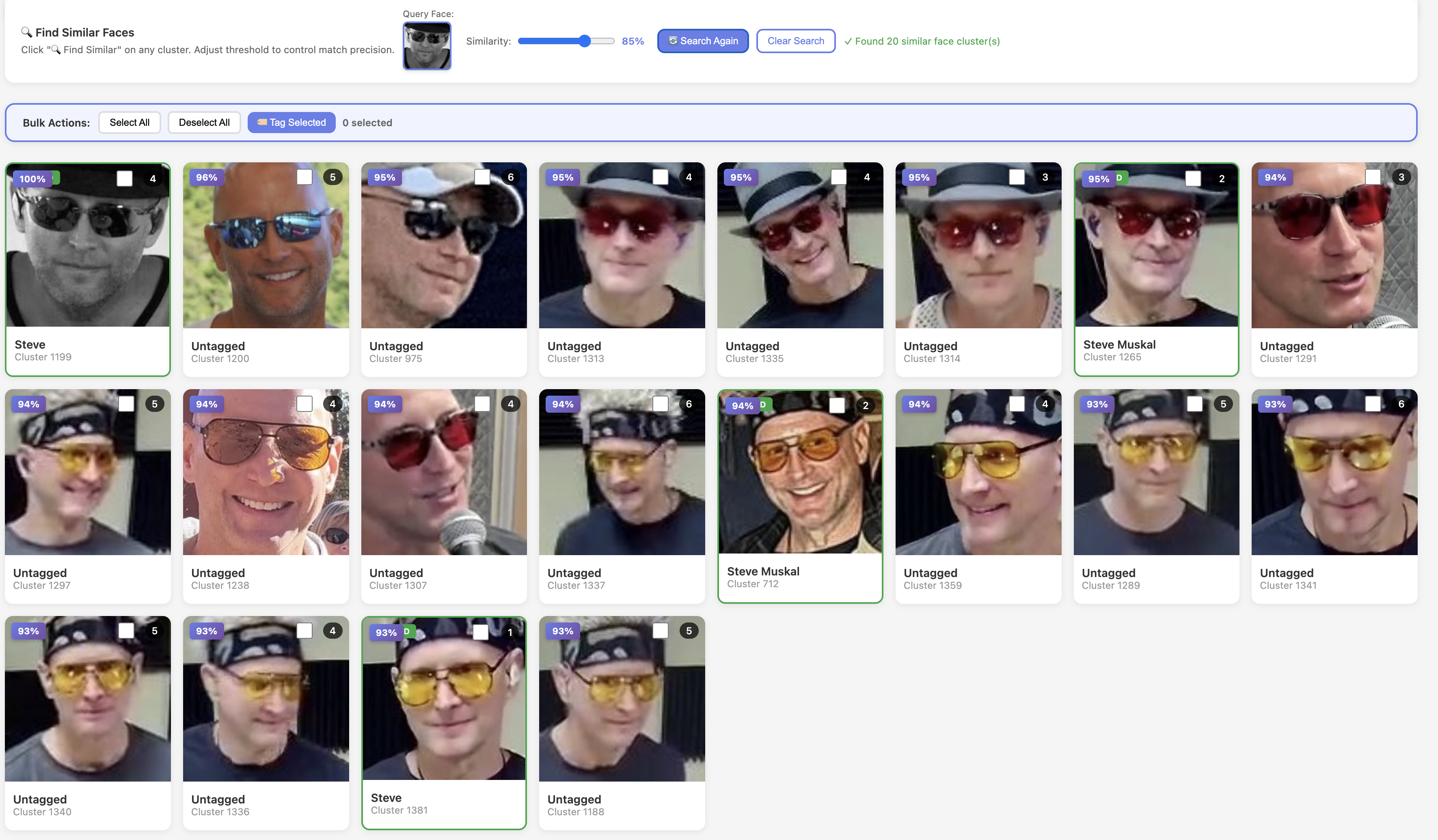
Robust matching across sunglasses, hats, and lighting to keep face IDs consistent.
AI-Steve Code Directives: Domain-Specific Auto-Coding
Added into my AI-Steve infrastructure is the ability to auto-code projects in a domain-specific way using simple natural language project descriptions on top of Droid, Claude, and/or Codex. What brought it to the next level is using AI-Steve’s RAG system to wrap a project direction in my voice - imagine enabling all your coders to code given their own past projects and insights. It is akin to saying: build this new OS in the voice of Linus Torvalds.
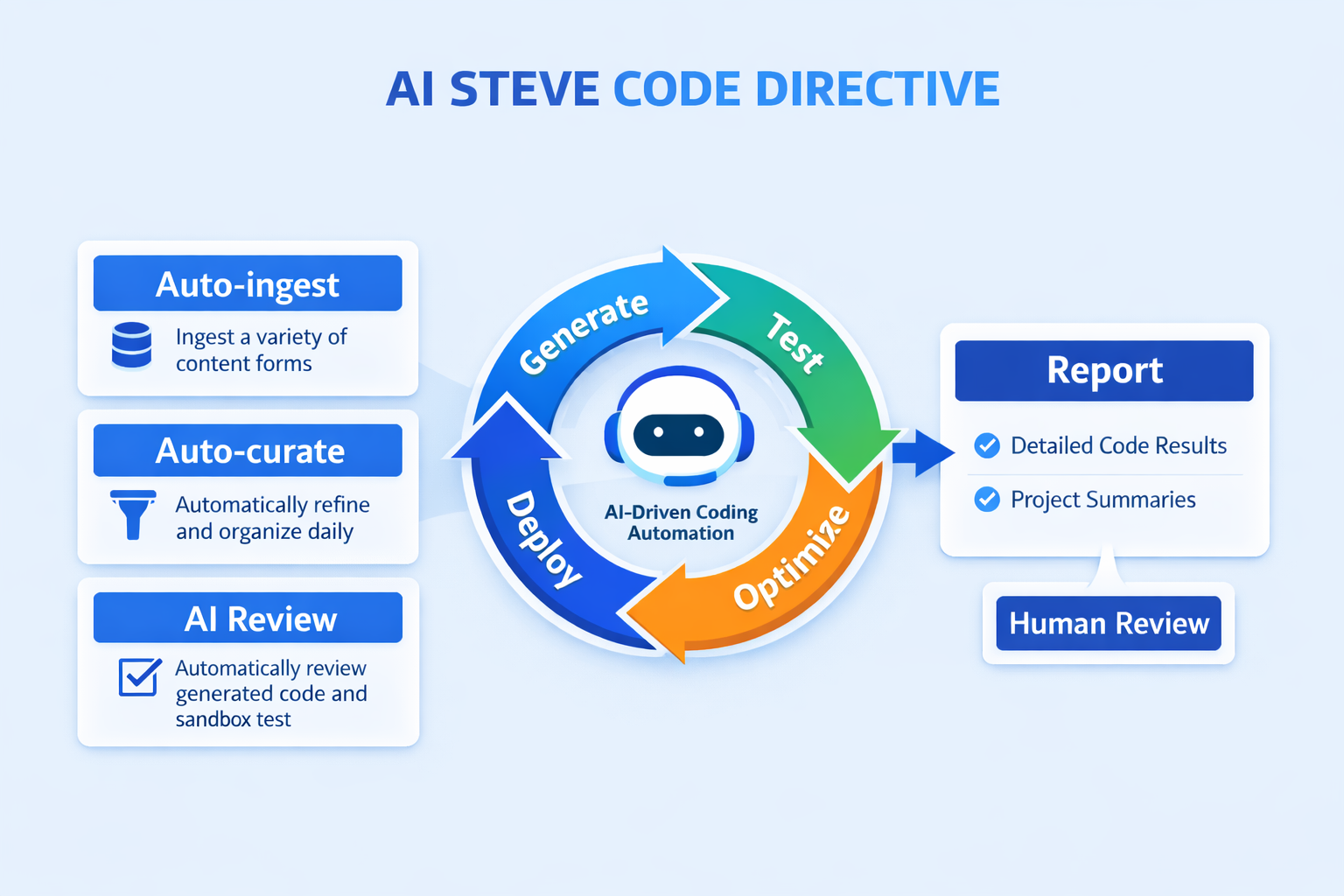
Domain-specific guidance + RAG voice overlay drive code generation, review loops, and polished reporting.
Key elements: domain prompts, RAG context, peer review, self-healing retries, and packaged reports.
Designed to make project requests feel like they were built by the same voice that created the original system.
Health Tech
5 projectsFood Health Scan
Food Health Scan turns meals into structured, reviewable nutrition data with photo capture, note capture, AI analysis, and fast edit flows. It is the practical product expression of the March 8, 2026 Renaissance Circle piece, Food Is Medicine. But First It Has to Become Data.



Current Demo
The existing walkthrough shows the current meal-to-data capture flow on the live app.
New V4 Demo
The newer V4 video adds another quick look at the updated Food Health Scan experience.
 New
Food Health TxD - Spot the meals that spike you
New
Food Health TxD - Spot the meals that spike you
The diabetes-aware companion to Food Health Scan. AI carb and macro estimation paired with continuous glucose monitor (CGM) data, so every meal links directly to the glucose response it produced. Built for people with Type 1, Type 2, and prediabetes who want to see what their food is actually doing - and for the wider 88 to 93 percent of American adults living with at least one metabolic risk factor.

What you see on the right
- Today view: glucose (mg/dL) plus carbs logged at meal times
- Scan Menu, Scan Food, and Log Glucose as one-tap actions
- Per-meal detail with CGM reading, macros, and timing
- Apple Health sync for hands-off CGM ingestion
- Showcase view that includes TxD plates alongside Food Health Scan
Companion essay (May 8, 2026): The Metabolic Crisis Is Not a News Story on Substack or Medium.
Live Food Showcase
This preview loads the live Food Showcase page, so updates on `foodhealthscan.com` show up here automatically. The showcase already includes TxD plates.

Share Health: App Store Export Companion
Share Health is the companion iOS app that makes consistent, time‑aligned Apple Health exports simple. It packages daily signals for longitudinal analysis with clean CSV outputs, optional face imagery, and on‑device Face → Health modeling.
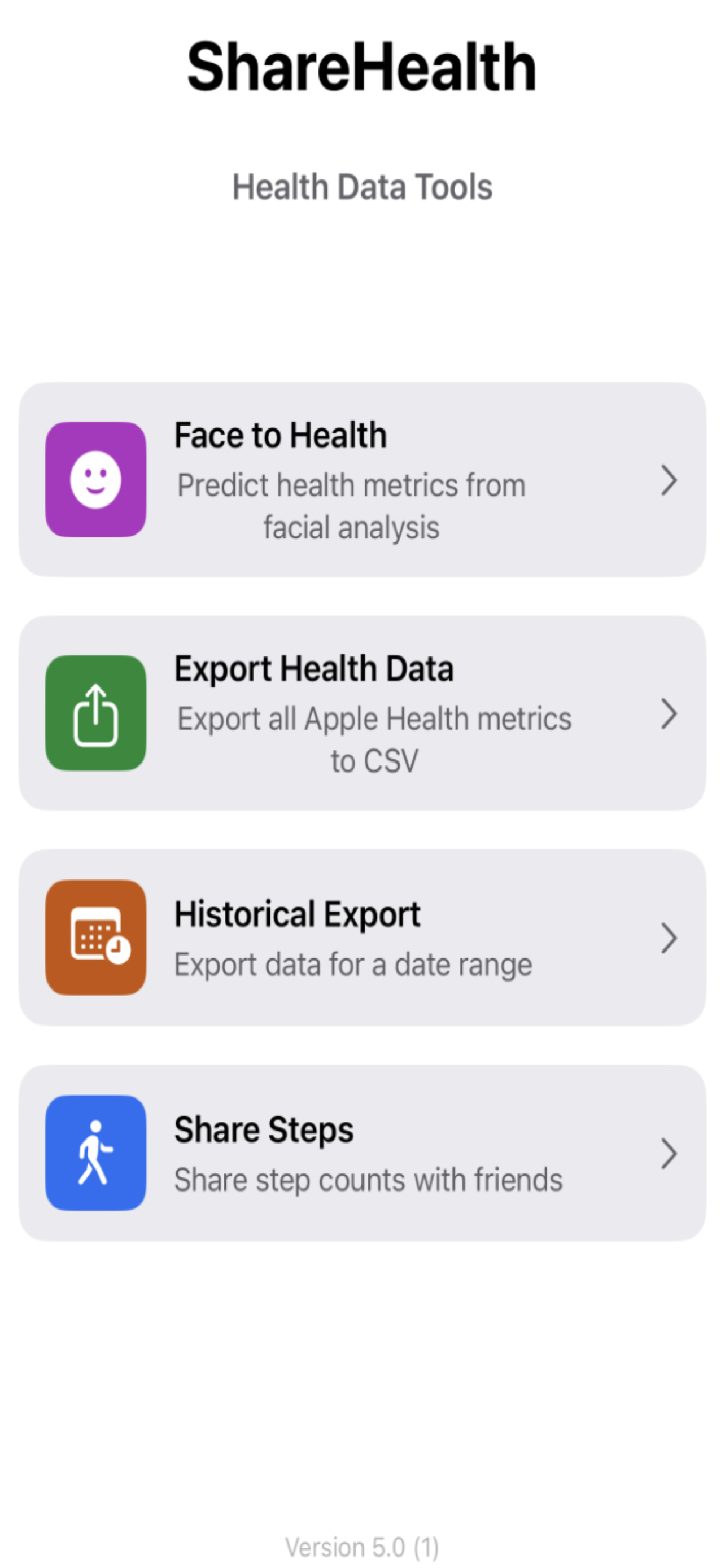
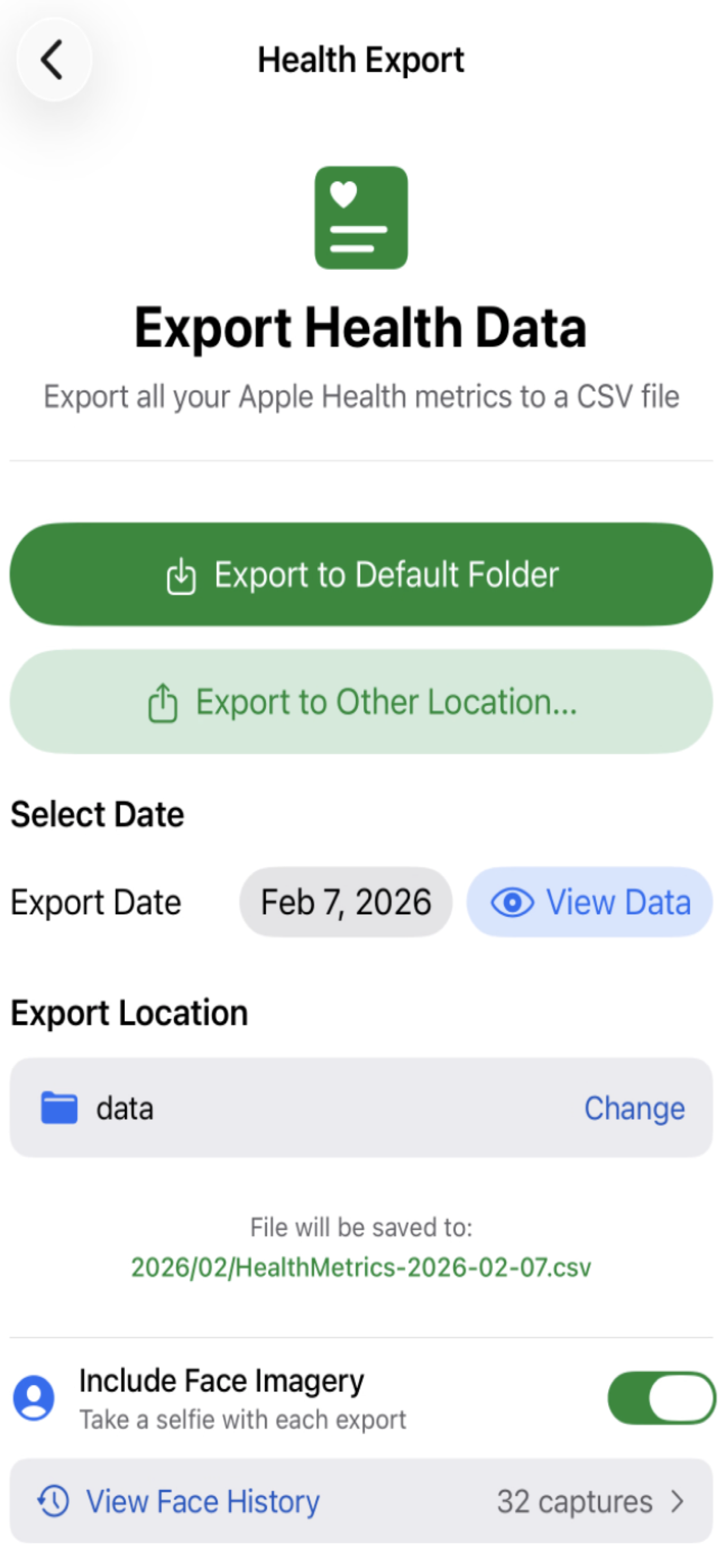
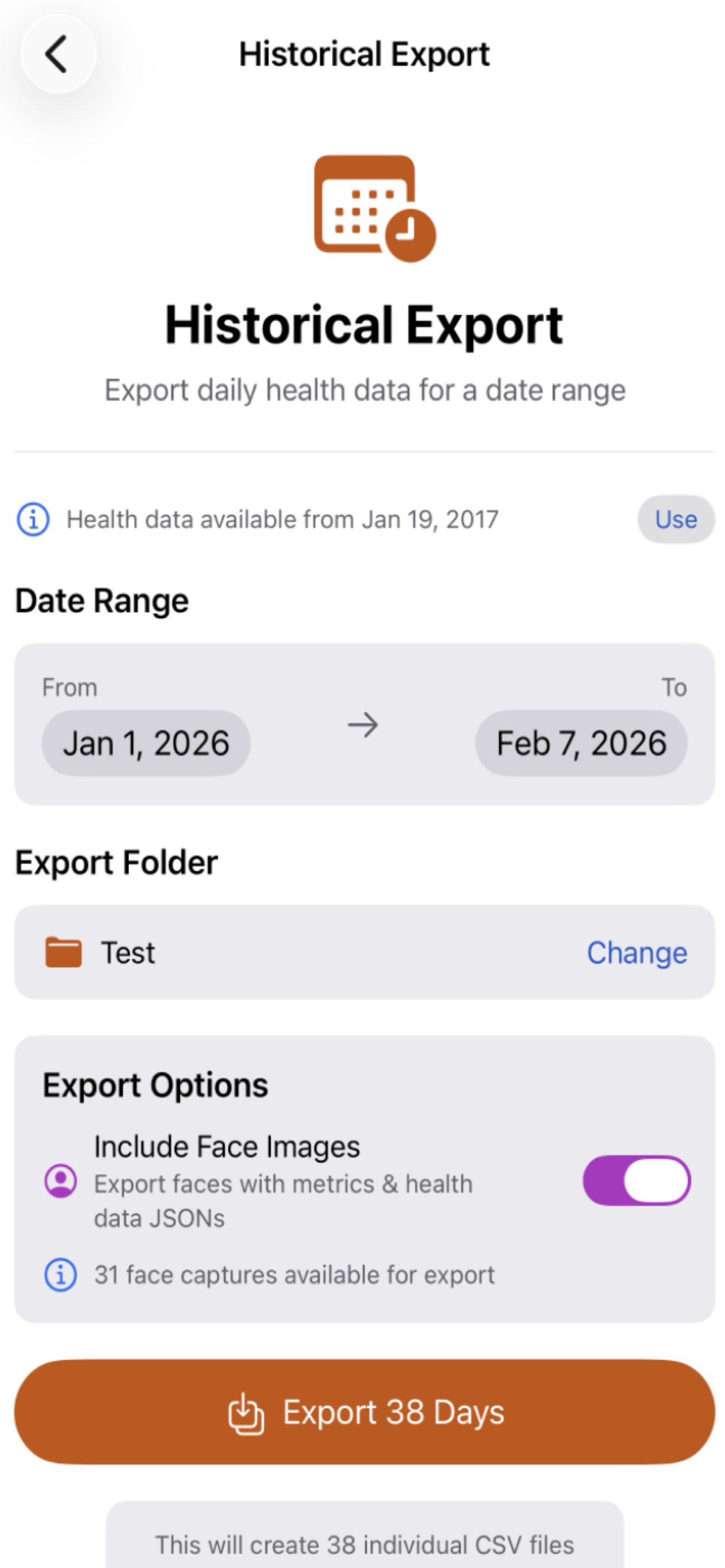
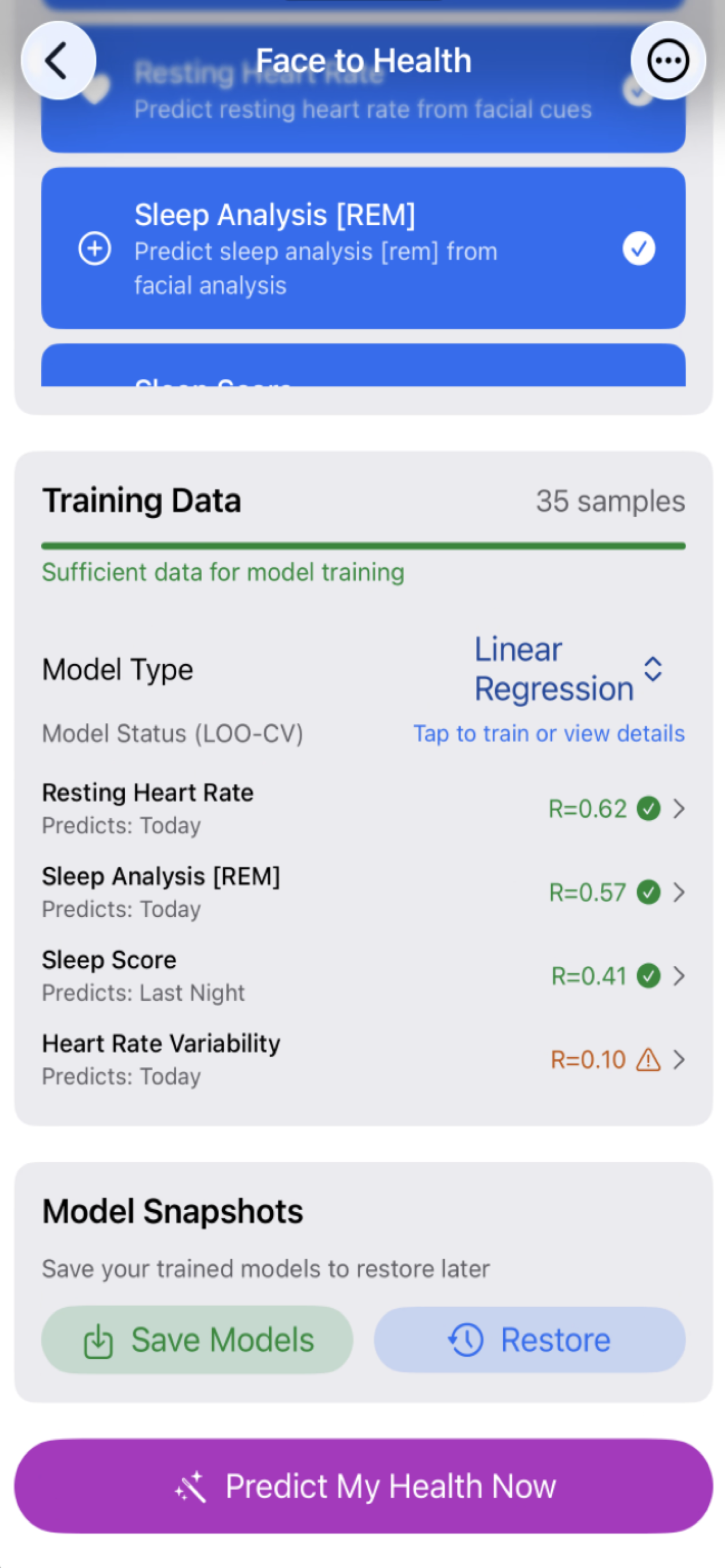
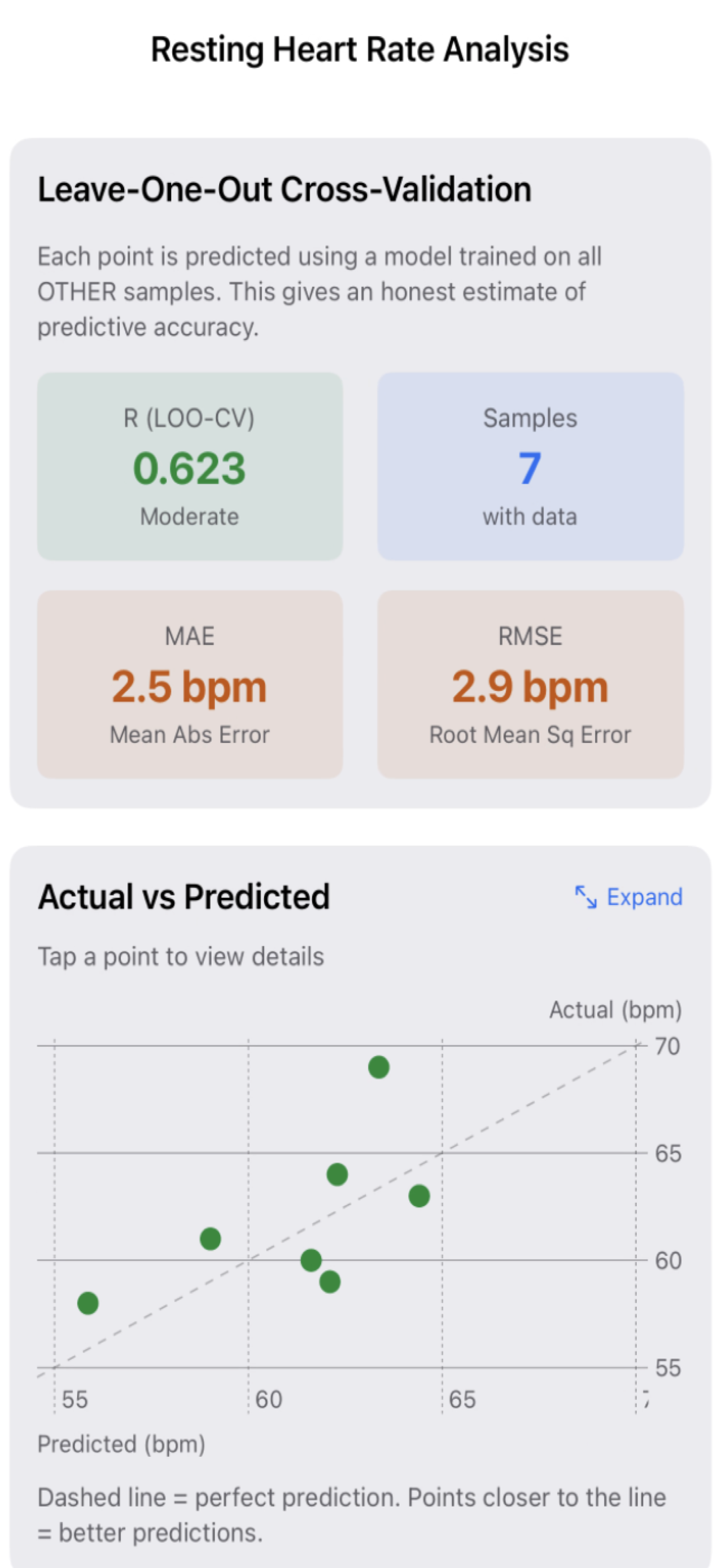
Face → Health modeling + export workflows (3×2 layout).
 GitHub Source →
Apple Health Integration: Quantified Sleep + Recovery
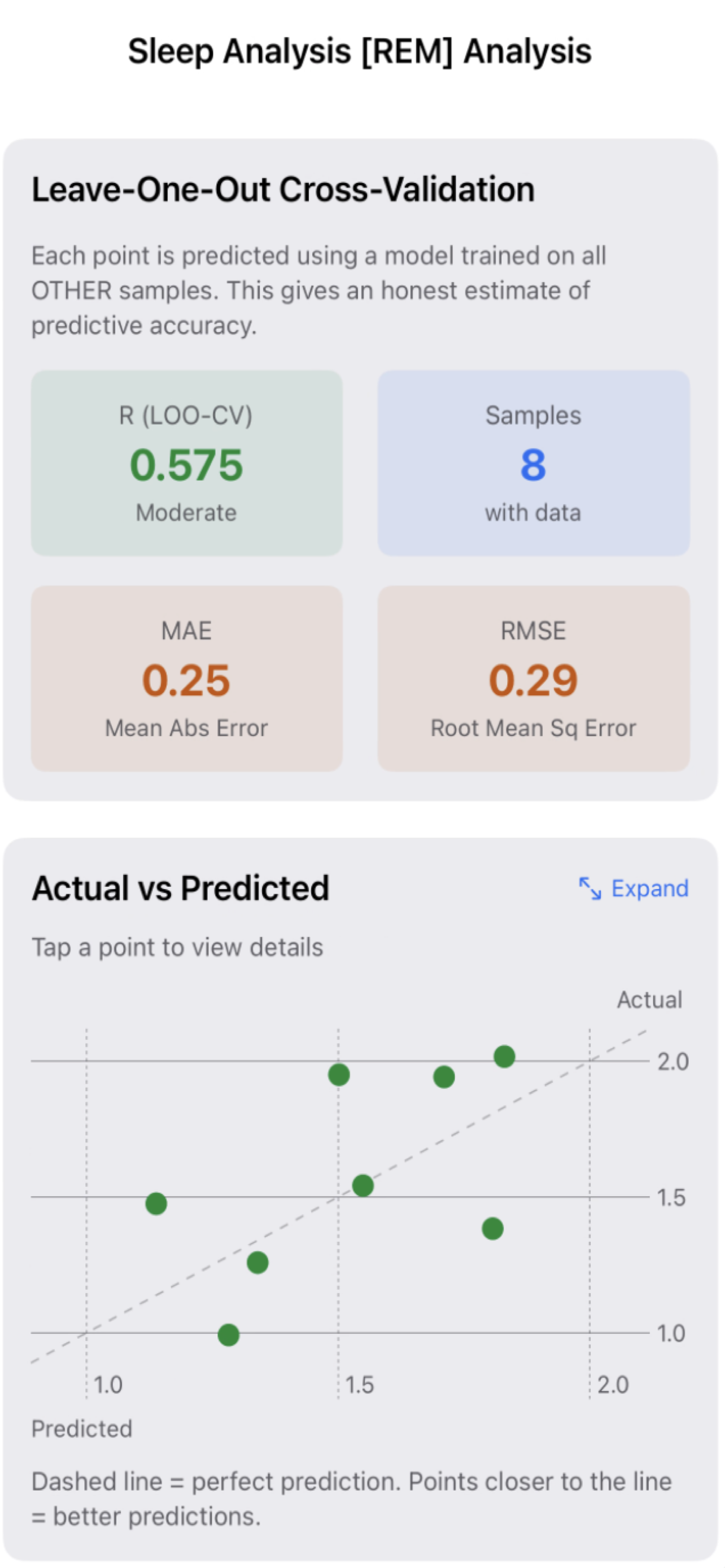
Daily Apple Health exports power a dedicated analytics pipeline inside AI-Steve. Correlation engines, lag analysis, and a sleep-concentration model surface the behaviors most tied to deep sleep and REM recovery. The resulting plots are stored as visual artifacts so they’re searchable and reviewable alongside photos and other memory assets.
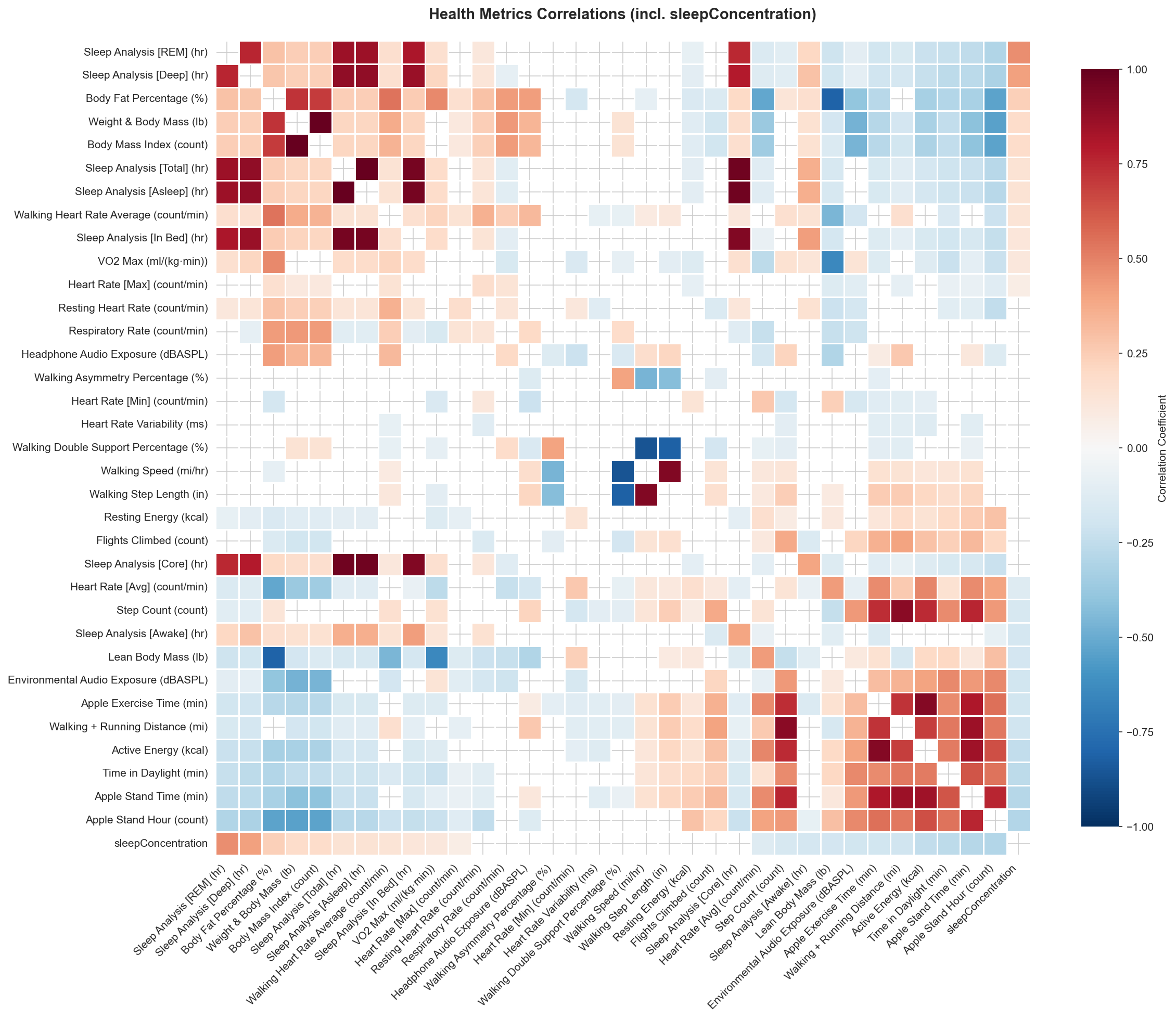
Full correlation heatmap across Apple Health metrics.
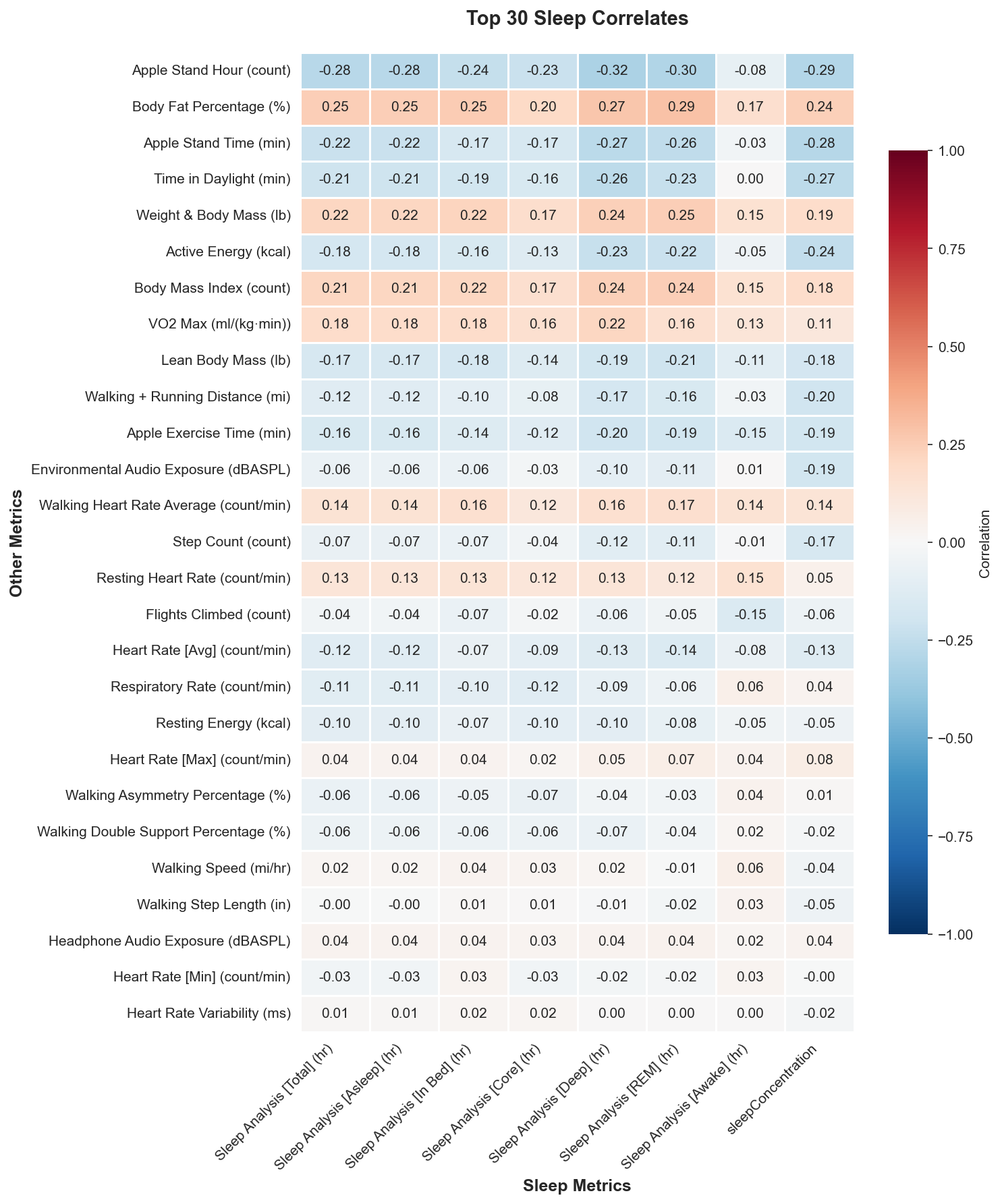
Sleep-focused correlation matrix highlighting top 30 predictors.
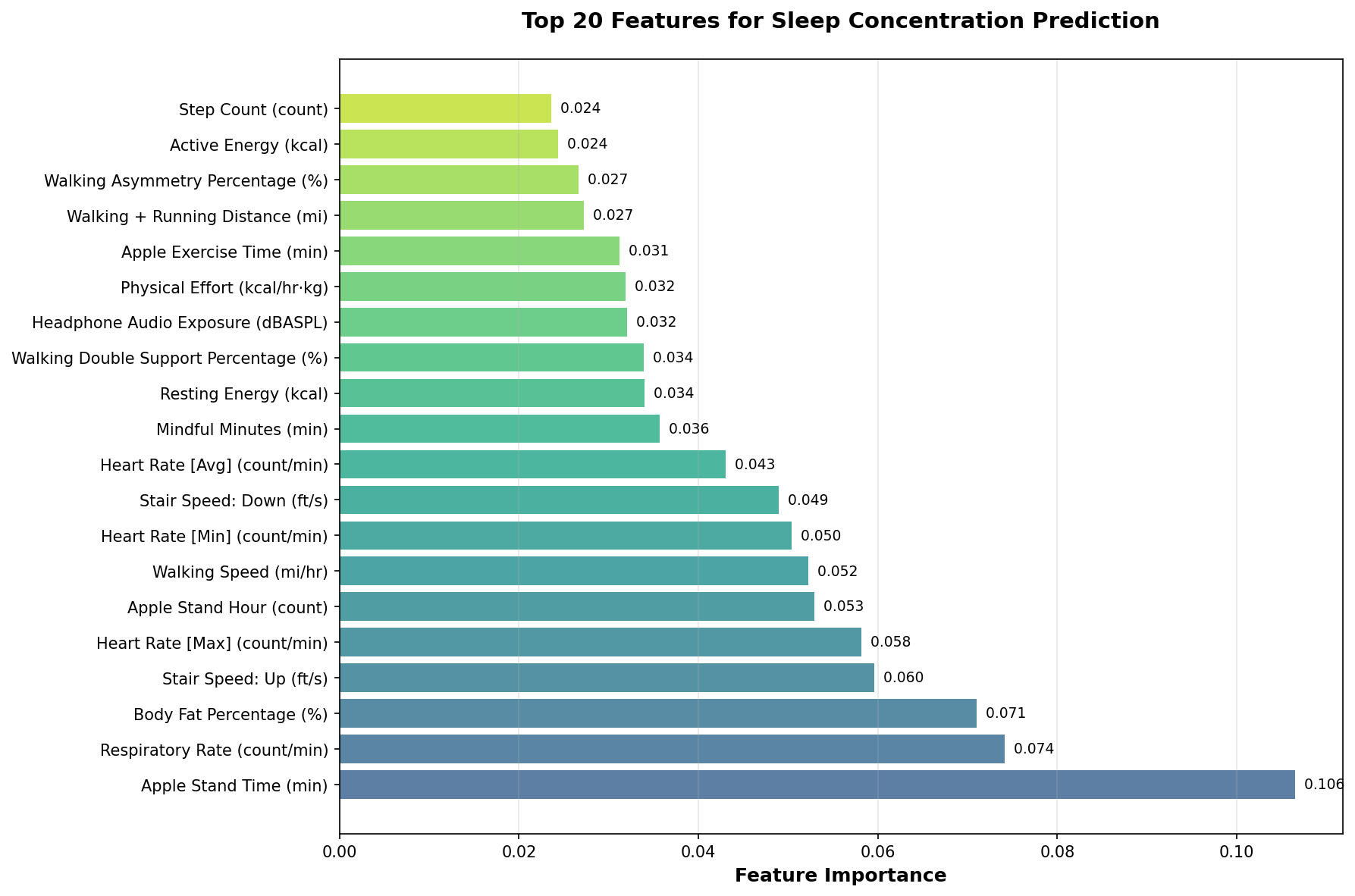
Top 20 features driving sleep concentration prediction.
.png)
Top correlates with deep sleep for recovery drivers.
.png)
Top correlates with REM sleep for cognitive recovery signals.
Face → Health: Vision as a Longitudinal Signal
Face → Health treats the face as a sensor, not a narrative. Daily images support both retrospective (last night) and predictive (tonight) sleep modeling with strict temporal alignment. Health-specific vision analysis, dual embeddings, and a materialized ML view make this a defensible, longitudinal wellness signal.
Temporal self‑awareness: face today → sleep tonight (recorded tomorrow).
CT Viewer Story: DICOM → Interactive 3D
A real-world build story: I received a USB drive full of DICOM CT slices after a root canal, and instead of using a PC-only viewer, I described the problem to an AI coding assistant and walked away. Minutes later, I had a working browser-based viewer with 3D rotation, cross-sectional MPR views, and contrast controls.
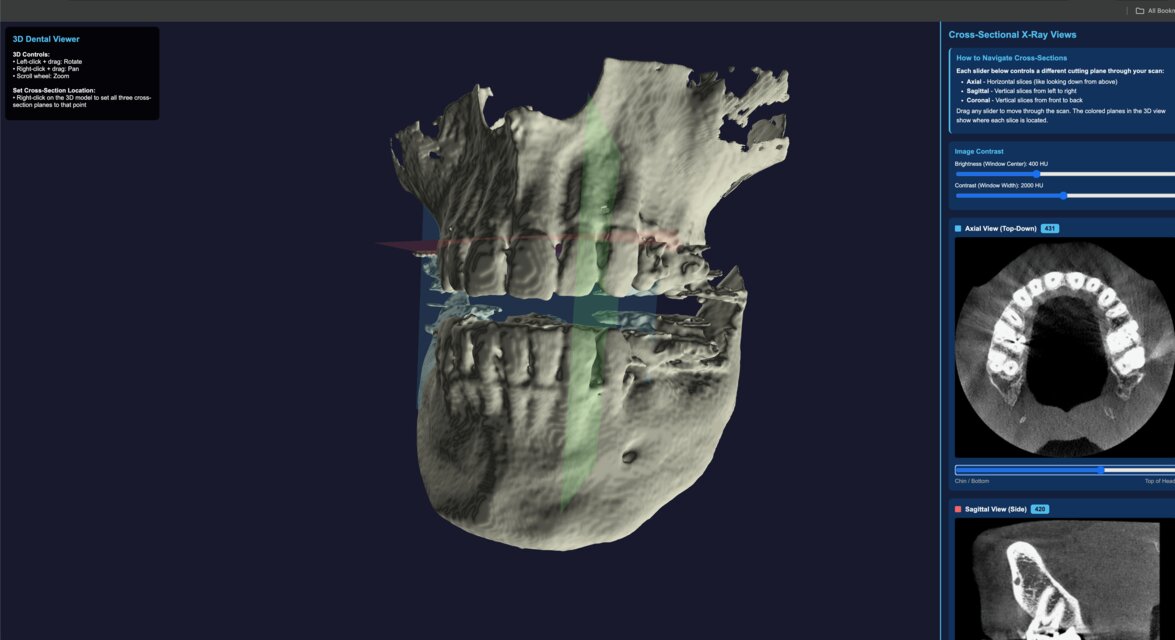
Interactive 3D jaw reconstruction with axial, sagittal, and coronal slice navigation.
Drug Discovery & Cheminformatics
3 projectsAI-Driven Drug Discovery
Developing machine learning models for predicting drug-target interactions and optimizing lead compounds to accelerate the path from discovery to clinical trials.
View Publications →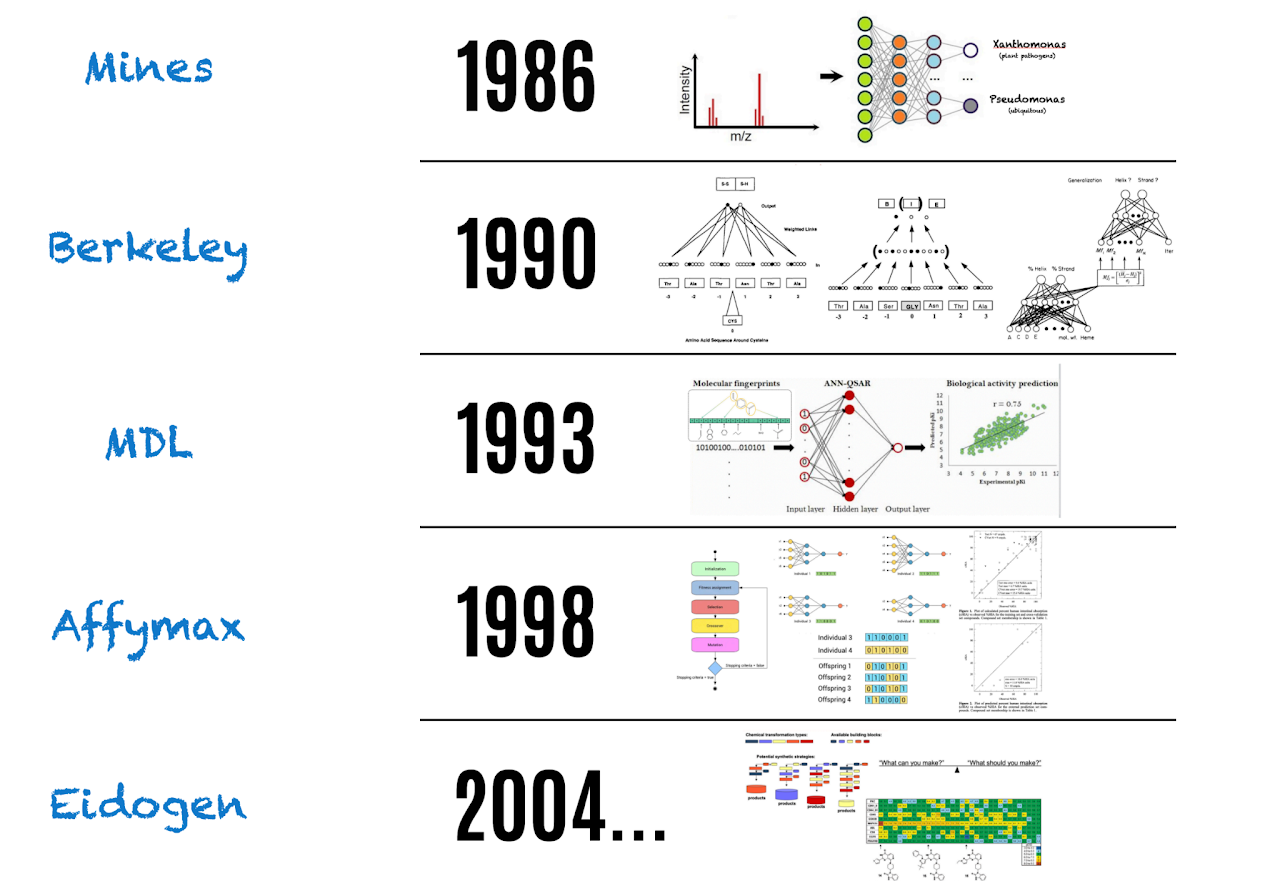
40+ years of neural network and AI research journey
Polypharmacophore / PharmPrint
Multi-conformer 3-point pharmacophore fingerprinting technology for AI-driven virtual screening, food-based drug discovery, and cross-species conservation analysis. Originally published in J. Chem. Inf. Comput. Sci. (1999, 2000) and reborn for AI-era natural-product matching.

Triplet-based pharmacophore matching across drug compounds, natural products, and target binding sites.
The same fingerprint is the objective function inside ChIP, which searches reaction routes for purchasable molecules that match a reference drug's pharmacophore on an unrelated scaffold. Almost everything useful you do with a pharmacophore fingerprint is comparative, and PharmCast now answers those comparisons from 2D structure alone. This is not a new way of mapping pharmacophores: the features, the triplets and the 10,549-bit encoding are unchanged, and what changes is the cost of asking how similar two molecules are, and a complete comparison of two molecules from their SMILES strings takes 0.584 ms against 5.71 s for the reference route, because it never builds a three-dimensional conformer at all. Building the peptide corpus that trains the composite model also turned up a result worth its own look: for short protein loops, sequence does not determine structure. Conformer generation is 98% of the real cost and the surrogate skips it, so ranking the complete 4.65 million compound Enamine collection against a reference takes 29.3 minutes, measured on one Apple M3 Ultra with PyTorch on CPU. That is what makes design search, catalog triage, 3D-aware clustering and scaffold hopping tractable at collection scale, with the per-conformer calculation still the arbiter that says which conformation carries the overlap. The same speed made it practical to profile that collection properly: all 4,612,044 in-stock Enamine compounds compared against every other, 10.6 trillion pairwise comparisons with no sampling. The library turns out to be wide in frameworks and deep in analogs around them, 679 distinct Bemis-Murcko scaffolds per thousand molecules yet a median nearest-neighbor similarity of 0.714, with 64,473 compounds carrying a 2D-identical twin. That is structural redundancy, not pharmacophoric.
🔬 Drug to Table Project (Finding Drugs Hidden in Your Food)
Remarkable 3D molecular alignment between Pravastatin (cholesterol drug) and Ganoderic acid from Reishi mushrooms. This innovative "reverse screening" approach explores how natural compounds in food mirror pharmaceutical drugs. Visit DrugToTable.com →
Creative Tools
1 project🥂 Toast Our Friend - A New Way to Celebrate
While the world focuses on self-promotion, we're building a place to honor the people around you. Share stories, create tributes, and celebrate the lives that touch yours.
Each app focuses on different communities and ways to celebrate friendships through meaningful connections.
Latest Renaissance Circle: Toast Our Friend
The newest Renaissance Circle post, Toast Our Friend, turns the idea behind Toast Our Friend into a larger call to move tributes upstream. Instead of saving the best stories for memorials, it asks people to gather video toasts, photos, gratitude, and memories while friends, mentors, and family can still hear them. The essay connects the first toast circles for Scott Miller, Mike Szwajkowski, Steve Cooper, Tom Shearer, and Sung-Hou Kim to the broader AI-Steve thread: use technology to preserve relationship, amplify appreciation, and make it easier to say the important thing now.